
BOARD EXAMS · TOUGH QUESTION STRATEGY · 2027 PREPARATION
How to Handle Tough Questions in Board Exams Without Panic
An actionable guide to staying steady when a question looks unfamiliar: read carefully, break it down, begin with known steps and use exam time wisely.

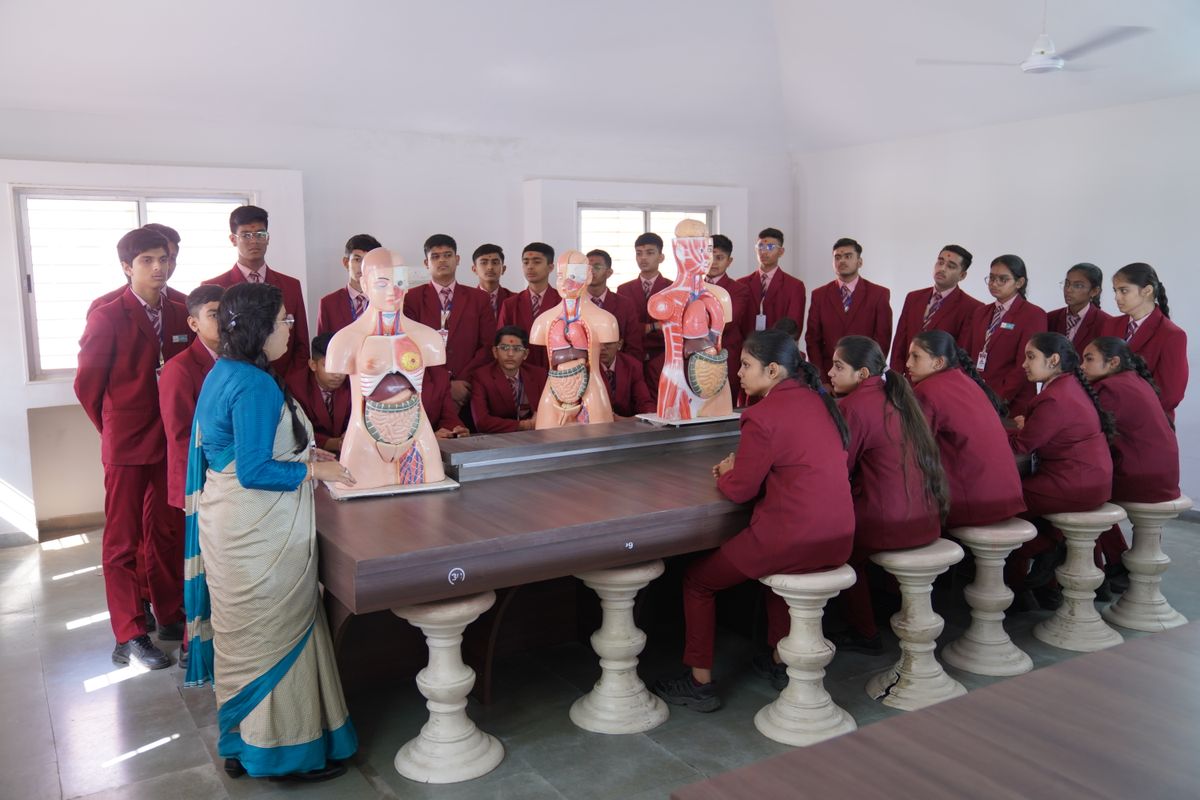
Students reviewing study materials in a contemporary library in Gujarat, India—not a staged 2027 board-exam scene.
What should you do first when a board exam question feels too difficult?
Short answer: Pause for a few seconds, read the question again, identify its command word and conditions, and write down what you definitely know. Divide the task into smaller parts. If you cannot progress after a reasonable amount of time, follow the paper rules and return after attempting other questions.
| Step | Action | Purpose |
|---|---|---|
| 1 · Pause | Slow down briefly; steady your attention | Reduce rushed mistakes |
| 2 · Decode | Find the command, topic, restrictions and marks | Understand the exact demand |
| 3 · Break down | Split subparts and write known information | Create an entry point |
| 4 · Decide | Solve now or return later if allowed | Protect time for other questions |
| 5 · Check | Verify steps, units, labels and numbering | Catch avoidable errors |
Important: These methods help you respond more deliberately; they cannot guarantee a correct answer or a particular score.
Why tough questions can trigger panic—even when you have studied
A long question, unfamiliar wording or a formula you cannot immediately recall can pull your attention away from the actual task. You may start worrying about your remaining time, then rush or freeze. The objective is not to eliminate every uncomfortable feeling, but to return attention to the next manageable action.
- Recognise the reaction: “This looks difficult” is a thought, not proof you cannot solve it.
- Avoid predicting your final marks from one question.
- Use a small repeatable routine instead of trying to force confidence.
- If stress is persistent or overwhelming outside the exam, seek help from a trusted adult, teacher or qualified professional.
Our guide to reducing exam stress and anxiety offers additional preparation strategies.
Which official materials should you use for 2027 board preparation?
As of October 2026, CBSE provides Class 10 and Class 12 2026–27 sample question papers and marking schemes. Use the sample paper for your exact subject to see its instructions, choices, command words and expected answer form.
Different subjects and education boards may use different section layouts, durations and mark allocations. Always follow the instructions on your actual 2027 question paper and the official examination-day notices; do not assume a generic “one hour for long answers” timetable applies everywhere.
Verified 2027 preparation: These official sample-paper resources are available now. Separate 2027 exam-day instructions should be rechecked when published.
Use a short pause to regain your attention
If you feel your thoughts racing, stop writing for a moment, relax your shoulders and take a comfortable breath. Keep the pause brief so it supports—not replaces—attempting the paper.
- Look at one sentence of the question at a time.
- Ask yourself: “What is the task asking me to produce?”
- Notice any solvable quantity, familiar term or obvious first point.
- Take the next step rather than waiting until you feel perfectly calm.

Decode command words before recalling the chapter
Difficult questions become more manageable when you work out what kind of answer they require. The command word often tells you whether to give a definition, a reason, a comparison or a calculation.
| Word | What to do | Example response |
|---|---|---|
| Explain | State the idea and why/how it happens | Describe why diffusion is faster in gases |
| Compare | Use common criteria for both items | Gas versus liquid particle motion |
| Analyse | Break down causes, effects or relationships | Link industrialisation with social and economic changes |
| Justify | Support a position using relevant evidence | Give a reason grounded in the chapter |
| Calculate | Show appropriate working and units | Given → formula → substitution → result |
| Evaluate | Weigh points using the requested criteria | Benefits and limitations, when asked |
Read our broader guide on board exam preparation strategies for more help interpreting tricky phrases.
Worked example: a difficult Science explanation
Question: “Explain why diffusion generally occurs faster in gases than in liquids.”
- Recognise the command: “Explain why” requires a cause, not just a definition.
- Identify the concept: Differences in particle movement and intermolecular spacing.
- Answer directly: Gas particles typically have greater freedom of movement and diffuse more rapidly under comparable conditions.
- Stay on topic: Do not write everything you know about the three states of matter.
Note: The precise school-level explanation depends on the wording and assumptions in your syllabus. This example illustrates how to extract the required reason.
Break a long question into smaller, checkable parts
A complex question may have two or three required elements. Instead of seeing one overwhelming paragraph, turn it into a mini-checklist.
Example: “Discuss the causes and social and economic effects of industrialisation in India.”
| Mini-task | What belongs in the answer |
|---|---|
| Causes | Relevant historical reasons for industrial growth |
| Social effects | Changes in communities and work, tied to the time period |
| Economic effects | Changes in production, jobs, trade or income as supported by the textbook |
| Final check | Did you address each requested part? |
If the question asks for “any two,” two accurate points may be enough; unnecessary extra paragraphs can consume valuable minutes.
Start with the part you know—and build logically
When an entire answer does not come to mind, begin with a valid first step. For a numerical, write the given quantities, the unknown and a relevant formula if you know it. For a theory answer, begin with the accurate fact or definition that addresses the question.
- Write only information that is relevant to the question.
- Show intermediate workings when required by the paper.
- Do not fabricate missing facts or force an unrelated formula.
- Remember that partial credit depends on the marking scheme and cannot be promised for any step.

A five-step method for unfamiliar Maths and numerical questions
Use a stable sequence to prevent skipped information: identify the target, list given values, choose an appropriate relationship, solve one step at a time and verify the result.
| Stage | Student self-check |
|---|---|
| Given | Which numbers and units are provided? |
| Find | What exactly is the unknown? |
| Method | Is the formula or theorem valid here? |
| Working | Have I shown necessary substitutions and steps? |
| Result | Does the answer have the correct unit/sign and make sense? |
If you reach an impasse, do not spend disproportionate time on a low-mark question when other compulsory work remains.
Eliminate options in MCQs without blind guessing
In objective questions, eliminate answers that contradict a known fact, unit or condition. Then compare the remaining options carefully. This is more reliable than choosing an answer because its wording sounds familiar.
- Read the complete stem and all options.
- Look for negatives such as NOT or incorrect.
- Rule out choices using evidence, dimensional checks or definitions.
- Check the specific paper rules: a test may have no negative marking, negative marking or other conditions.
- Never assume guessing is always beneficial.
Illustration: For a molecular polarity question, use molecular geometry and bond dipoles rather than a memorised shortcut alone.
Use a quick diagram or flowchart when it genuinely helps
A small sketch may clarify direction, sequence or relationships in a complex problem. It is useful for physics circuits, geometry, biological systems and some economics diagrams—but draw only when relevant and permitted.
- Label a necessary quantity or part clearly.
- Keep rough sketches separate from the final required answer when instructed.
- For a heart question, sketch blood flow only if it supports what is asked.
- A neat, labelled diagram is not a substitute for a required explanation.
Make a time budget that suits your subject
Time management prevents one difficult question from consuming the time needed for several others. Decide on a flexible writing budget using your subject’s actual duration, marks and section instructions.
Illustrative, not official: If you have 150 minutes of writing time for an 80-mark theory paper and reserve 10 minutes for review, the remaining 140 minutes amount to approximately 1.75 minutes per mark on average. Adjust for reading passages, diagrams and calculations.
| Situation | Useful choice |
|---|---|
| A low-mark question is taking too long | Move on temporarily if order is flexible |
| A high-mark numerical is partly solvable | Write valid working within a time limit |
| The next section is compulsory | Prioritise completion as instructions require |
| Final minutes remain | Check numbered answers, units and subparts |
Use our board and competitive exam preparation guide to practise timing before the real exam.
When should you skip and return to a question?
If a question has no obvious next step after a considered attempt, moving to another question may be wise only if the paper permits that order. Note the question number so you can return without accidentally omitting it.
- Check whether question order is compulsory.
- Leave clear numbering; do not make answers hard to identify.
- Return after completing other higher-confidence required work.
- Do not abandon an entire multi-part question when some subparts are answerable.
Decision rule: Is there a clear, valid next step? If yes, continue within your time budget. If no, park it and return if allowed.
Make theory answers easy to follow
For History, Economics, Business Studies and language-based answers, a short structure is often more valuable than many unrelated sentences.
- Answer the question in the opening line when possible.
- Use distinct points for causes, effects or features.
- Add an example only when relevant to the command and marks.
- Keep dates and named events accurate; do not invent them to complete an answer.
- Match headings and any subparts to the printed question.
How to respond to an unfamiliar Chemistry or Biology question
Look for identifiable concepts: definitions, conserved quantities, reaction conditions, organs, pathways or labelled structures. If a problem has multiple subparts, tackle the ones you understand rather than treating the whole question as impossible.
| Subject | First useful action | Avoid |
|---|---|---|
| Chemistry | Identify species, relevant property and given conditions | Guessing an equation without balancing or checking |
| Biology | Identify process, required structure and labels | Adding unrelated textbook paragraphs |
| Physics | Draw a simple representation and note quantities | Using equations whose assumptions do not apply |
Use NCERT study strategies to strengthen the concepts behind varied question wording.
Replace catastrophic thoughts with practical self-talk
You do not have to convince yourself that every question is easy. Try more accurate statements that lead to action: “I can identify the topic,” “I will do one step,” or “I can revisit this later if permitted.”
- Avoid comparing your speed with other students in the room.
- Treat one hard question as one task, not a prediction of the whole paper.
- Keep attention on the next readable line or solvable subpart.
Review your difficult answers for easy-to-fix errors
When time is available, review the kinds of errors most likely to change an otherwise sound response. Do not rewrite large answers at the last minute without a clear reason.
- Check numerical signs, units, rounding and substituted values.
- Check graph axes, arrows and diagram labels.
- Confirm that every requested subpart and condition was answered.
- Check whether the final result addresses the command word.
- Ensure answer numbering is correct and all exam details follow the centre instructions.
Our guide on presenting board-exam answers neatly explains clear working and readable answer structure.
Practise challenging questions before exam day
Repeated, well-reviewed practice improves familiarity with unfamiliar wording. Start with official subject sample papers and previous papers, then work on questions that expose your weak concepts—not just questions you can already solve.
- Pick one challenging question from a verified source.
- Try it under a reasonable time limit.
- Compare your answer with its official marking scheme or teacher feedback.
- Categorise the error: concept, question-reading, calculation, time or presentation.
- Revisit a similar question after revision.
For timed practice options, see our guide to online mock-test platforms.
Keep a small “why I got stuck” error log
A mistake log makes preparation more targeted. It can show whether the same cause repeats across Maths, Science and theory papers.
| What happened | Likely reason | What to practise |
|---|---|---|
| I read “compare” as “describe” | Command word misread | Underline commands on practice copies |
| I forgot the next algebraic step | Method gap | Review worked examples and try again |
| I spent too long on one question | Time-allocation problem | Timed sets and return rule |
| I missed a diagram label | Incomplete checking | Final-answer checklist |
| I panicked at a long paragraph | Task looked bigger than it was | Split multi-part questions before solving |
Does guessing help if you do not know the answer?
The answer depends on the examination rules. In an objective item without negative marking, a reasoned guess may be worth considering if you must choose. Where negative marking exists, balance your confidence and the scoring rule. Some questions require written explanations rather than guesses.
Do not confuse exams: CBSE board papers, state board papers and competitive entrance tests can follow different scoring rules. Read the exact instructions instead of relying on general advice.
A simple exam-day checklist for tough questions
- Read instructions and each question completely.
- Pause briefly when you feel rushed.
- Circle the key word in your mind or on a permitted practice copy.
- Find the given facts and one valid starting step.
- Split the question into subparts.
- Use allowed question-order flexibility responsibly.
- Reserve any practical review time for signs, units and omitted answers.
Before the exam, consider our common exam preparation mistakes checklist too.
Seven-day practice plan for handling tough questions
The following is an adaptable example, not an official prescribed schedule. Keep each session short enough to maintain quality rather than exhausting yourself.
| Day | Practice exercise | One thing to review |
|---|---|---|
| 1 | Read difficult questions; identify command words | Did you understand the exact request? |
| 2 | Solve two short numerical questions step by step | Were units and signs correct? |
| 3 | Break three multi-part theory questions into sub-tasks | Did you address each part? |
| 4 | Practise eliminating options using concepts | Was each rejection evidence-based? |
| 5 | Attempt a short timed mixed set | Did you protect time for remaining questions? |
| 6 | Review incorrect solutions with a marking scheme | Concept gap or reading error? |
| 7 | Retry selected errors and practise a brief reset | What improved, what needs revision? |
Frequently asked questions about difficult board exam questions
These questions cover panic, unknown formulas, partial answers, MCQs, time management and official 2027 preparation resources.
What should I do if I panic when I see a hard question?
Pause for a few seconds, breathe comfortably, reread the instructions and identify the smallest valid next step. If you cannot progress, return later when the exam rules allow.
Should I skip difficult questions in a board exam?
You can consider returning to a question later only where the instructions permit flexible order. Answer any solvable subparts and keep the question number clear.
Can I get marks for partially solved Maths questions?
Some marking schemes award credit for valid intermediate steps, but the conditions vary by question. Show appropriate working and do not assume every step earns a mark.
What if I forget a formula during a board exam?
Write the given information and the target quantity, then check whether a known theorem or relationship applies. Avoid inventing a formula. Return later if permitted.
How do I manage time on very difficult questions?
Use the actual paper duration, mark distribution and instructions to set a flexible time budget. Move on when a question consumes too much time relative to other required work, if allowed.
Does deep breathing immediately stop exam panic?
A short comfortable breathing pause may help some students settle their attention, but it is not a guaranteed way to stop anxiety. Seek support if panic is frequent or severe.
Is guessing safe in board exam MCQs?
Check the exact rules. Without negative marking, a reasoned elimination-based choice can sometimes help. With negative marking, guessing may reduce the score.
How can I answer a long question I do not fully understand?
Identify the command words and separate required subparts. Work through the parts you recognise and avoid irrelevant facts or unsupported guesses.
How can I solve tough Science questions more effectively?
Identify the relevant law, process, given quantities or diagram. Write a valid starting step, then connect each point directly to what the question asks.
Where can I find official sample papers for 2027 CBSE board exam preparation?
CBSE publishes Class 10 and Class 12 sample question papers and marking schemes for the 2026–27 academic session at cbseacademic.nic.in.
What is the best way to practise difficult board questions?
Attempt verified sample or previous papers, review official marking schemes, record why you got stuck and retry similar questions after targeted revision.
How do I avoid repeating mistakes in difficult questions?
Record the specific cause, such as misreading, formula confusion or time pressure, and practise a targeted correction rather than simply repeating whole papers.
Final takeaway: one clear step is better than panic
Hard questions need not control the rest of your exam. Read carefully, take a brief reset, break the task down, start with a valid known step, manage your minutes and review where possible. These techniques improve the chances that your existing knowledge appears clearly on the answer sheet.
For 2027 preparation, practise with verified 2026–27 CBSE papers for your subject or the corresponding material from your board. No strategy replaces understanding the syllabus, and no technique can guarantee particular marks.
Try this today: Pick one genuinely challenging sample-paper question. Before solving, write the command word, the required subparts and the first known step. Then check your completed answer against the marking scheme.