BOARD EXAM PREPARATION · CLASS 10 & 12 · 2027 GUIDE
How to Improve Accuracy in Board Exams Without Increasing Study Hours
Stop losing avoidable marks to misread questions, skipped steps and last-minute rushing. Learn a practical, 2027-ready accuracy system for Indian board students—without extending your study day.

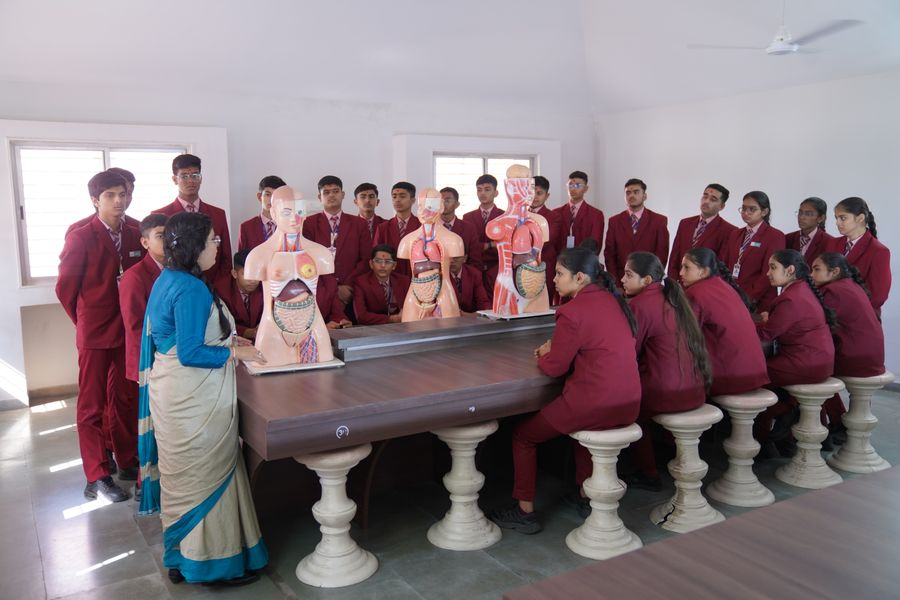
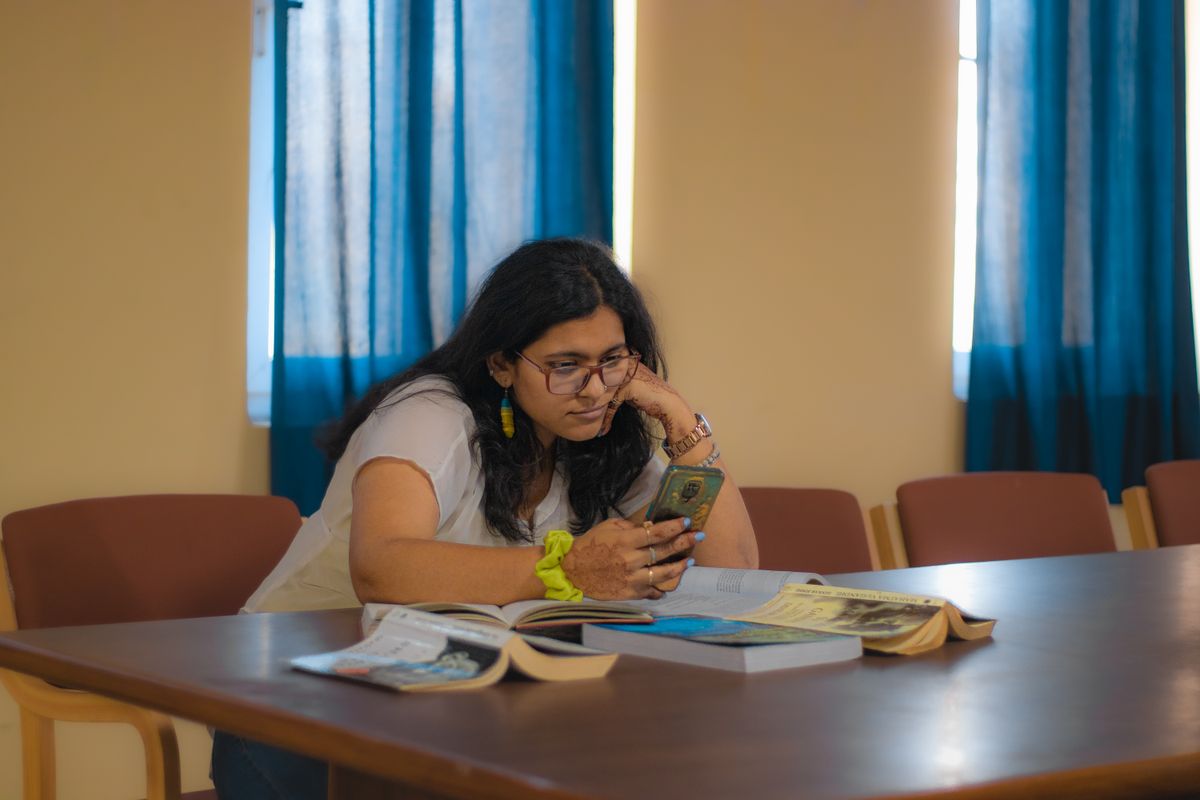
Real Indian students studying with books and a laptop on campus. Photo: Kiran Pokuri Photography / Pexels.
How can you improve board-exam accuracy without studying longer?
Short answer: Keep your study time roughly the same, but spend more of it on interpreting questions, solving and checking answers, retrieving facts without notes, and correcting repeat errors. During the exam, follow the instructions, show essential steps and leave a realistic review buffer. Accuracy means fewer avoidable mistakes—not perfection.
For Indian Class 10 and Class 12 board candidates in 2027, this is a more useful target than copying someone else’s long timetable: answer a representative set of questions, identify why marks were lost and practise the specific fix. Your board’s latest official sample question papers and marking schemes—not a generic timetable—should determine how you practise.
| Common mark loss | Small change to make | Proof it worked |
|---|---|---|
| Misreading “compare” as “describe” | Underline the instruction word mentally or on allowed rough work | Answer directly matches the task |
| Omitting a unit | Check the final line of each numerical answer | Value and unit both present |
| Forgetting a keyword | Brief closed-book retrieval | Can explain without notes |
| Repeating the same mistake | Log the cause and retest | Correct answer on a later similar question |
2027 note: CBSE has published 2026–27 Class X and XII sample question papers and marking schemes; use the relevant official subject files. State-board students should use their own board’s current documents. Do not assume one marking pattern fits every board or subject.
What accuracy really means: precision before speed
Accuracy is the proportion of attempted questions or scoring points answered correctly. Speed is useful only when it does not come at the cost of correct interpretation and presentation. The purpose of timed practice is to find a sustainable balance.
| Practice record (illustrative) | Attempted | Correct | Accuracy |
|---|---|---|---|
| First short test | 20 | 14 | 70% |
| After focused corrections | 20 | 17 | 85% |
In this simple example, accuracy increases by 15 percentage points while the number of questions stays unchanged. Actual board marks also depend on partial credit, presentation, negative marking where applicable and the published marking scheme; question-count accuracy is only a practice metric.
Do not rush to match a friend’s finishing time. Instead, record: minutes used, errors made, and the reason for each error.
1. Read the question for its command, scope and marks
Before writing, identify three things: what the question asks, which content it covers, and how much detail the marks and instructions require. This usually saves more time than writing a long irrelevant response.
- 1Spot the command word
“Define” asks for meaning; “compare” asks for similarities/differences according to context; “justify” needs a reason; “calculate” requires working.
- 2Check qualifiers
Words such as not, except, two causes, with examples change the required answer.
- 3Match the scope
Give the requested number of points, with a clear explanation where required by the marking criteria.
Example: “Compare mitosis and meiosis” does not ask for two independent essays. A compact comparison covering the expected distinguishing features is more directly responsive. Spend a few seconds decoding longer instructions, not a fixed 15 seconds on every one-mark question.
2. Replace blind repetition with targeted exam-style practice
Practice only becomes useful when it tells you what to change. Choose an appropriate question set, solve it without looking at the solution, compare with a trusted marking scheme or teacher feedback, and then retry the weakest skill.
Try a 25-minute accuracy block: 15 minutes solving, 7 minutes comparing against criteria and 3 minutes writing a correction. Adjust the length to the question type. The goal is better feedback inside your normal study time, not an extra late-night session.
For exam preparation mistakes that repeatedly cost marks, see our board-exam mistakes checklist.

3. Break numerical and science questions into checkable steps
Complex problems are easier to verify when every key step is visible. In mathematics, physics and chemistry, the common accuracy checklist is given → method → substitution → calculation → units → reasonableness, adapted to the problem.
Worked illustration: Solve 2x² − 5x + 2 = 0. Identify a = 2, b = −5 and c = 2. Factorise as (2x − 1)(x − 2) = 0. Thus x = 1/2 or x = 2. Substitute at least one root back into the original equation when time permits. The check catches sign and arithmetic errors.
For a Physics calculation, verify whether a final quantity needs SI units, significant figures or direction. In Chemistry, recheck balanced equations and state symbols when the question asks for them. In Biology, verify diagram labels against the structures actually drawn.
4. Revise with retrieval, spaced practice and precise notes
Rereading feels familiar, but familiarity is not the same as being able to produce a correct answer. After understanding a topic, close the book and retrieve the definition, formula, explanation or diagram from memory. Check and correct what was missing.
- Flashcards: useful for definitions, formulas and dates, when checked against a reliable source.
- Mind maps: useful for organizing connected ideas; redraw from memory rather than just decorating a page.
- Timeline cards: useful for arranging historical events chronologically.
- Spaced revisits: return to a topic after a delay; the interval is flexible, not a compulsory formula.
A classroom study of retrieval practice, alongside decades of educational psychology research, supports active retrieval for retention. It does not prove that any single revision technique guarantees higher board marks. Explore science-backed revision strategies and how to avoid forgetting what you study.

5. Understand concepts rather than memorising their wording
Conceptual understanding helps when board questions change the context. For example, Newton’s second law relates net force, mass and acceleration; knowing F = ma is helpful, but understanding what changes when force or mass changes makes unfamiliar problems more manageable.
Try the teach-back test: explain a concept in three sentences, use one example and solve one question that applies it. If you cannot explain why your steps work, return to the textbook or ask your teacher. For NCERT-based courses, consult the prescribed NCERT text alongside your official syllabus.
6. Study one task at a time and protect attention
Frequent phone checking interrupts thought and makes it harder to notice a missing step. Create a distraction-reduced session: place your phone away, choose one task and keep only the required book or tool open. A 25–30 minute block can work for some tasks; longer problems may need more uninterrupted time.
| During a focused block | Do this instead of… |
|---|---|
| Solving numerical questions | Switching to social apps between steps |
| Writing long answers | Copying memorised paragraphs without checking the prompt |
| Checking work | Only scanning the answer key and moving on |
If your device is needed for a digital paper, open only that resource. See our digital minimalism and concentration guide for additional ideas.
7. Use a flexible time budget during the actual examination
Read the paper instructions first and plan time according to the actual number of sections, marks, optional questions and question lengths. Do not blindly follow a fixed 90/60/30-minute split: different board papers need different approaches.
- 1Read instructions and scan the paper
Check total questions, internal choices, compulsory sections and any restrictions on answer order.
- 2Assign time by work required
Use marks as a guide but account for reading, calculations, diagrams and handwriting.
- 3Move on when stuck
If rules permit returning, mark the question for later rather than letting one item consume the paper.
- 4Reserve review time
Leave a buffer suited to the paper, even if it is only a few minutes. Check essentials first.
Example—not an official timetable: In a three-hour paper, a student might provisionally reserve 10 minutes for reading and planning, 150–155 minutes for answering, and 15–20 minutes for review. Change that split after practising with the exact official paper format.
8. Double-check the answers most likely to lose easy marks
Review is most effective when it is selective. Start with questions you flagged as uncertain, then check for predictable error types: wrong sign, missing unit, incorrect question number, skipped subpart, mislabeled figure and unclear final response.
| Subject | Fast review checks |
|---|---|
| Mathematics | Signs, substitution, algebraic simplification, required steps and final answer |
| Physics | Formula choice, SI units, conversions and sensible numerical result |
| Chemistry | Balanced equations, oxidation states, units and molecular formulas where relevant |
| Biology | Scientific terminology, diagram labels and the requested number of differences |
| English | Question requirements, structure, grammar and basic spelling |
| History / Social Science | Dates, sequence, evidence and whether you addressed the command word |
Good answer presentation makes checking easier. Read our 2027 guide to presenting board answers neatly.

9. Reduce avoidable errors when pressure rises
Feeling anxious before or during an exam does not mean you are unprepared. If you lose your train of thought, stop writing briefly, relax your shoulders, take a few slow breaths and restart from the instruction word. This is a practical reset—not a promise to remove anxiety.
Avoid introducing new revision material in the final moments if it makes you more confused. Prioritise sleep, regular meals, permitted water and travel planning. For persistent or intense exam-related distress, seek support from a parent, teacher, school counsellor or qualified professional.
Our exam-stress and anxiety guide offers further low-pressure strategies.
10. Turn repeated mistakes into a short corrective plan
Keep an error log with only the information needed to make tomorrow’s practice smarter. It can live on one notebook page or in a simple spreadsheet. Do not copy an entire question paper into it.
| Error type | Example | Next action | Retest |
|---|---|---|---|
| Reading | Missed “except” in an MCQ | Circle qualifiers on practice sheets | 5 similar questions |
| Concept | Mixed up mitosis and meiosis | Re-explain the comparison from text | Two comparison prompts |
| Calculation | Negative sign lost | Mark each algebra step clearly | Three solved problems |
| Presentation | Diagram arrow unclear | Practice one correctly labelled figure | One redraw |
| Recall | Forgot a definition keyword | Flashcard plus closed-book explanation | One delayed retrieval |
Focus on your two most frequent error types first. Review the log after each practice paper and ask for feedback on mistakes you cannot diagnose yourself.

11. Use mnemonics only when they improve recall without distortion
Memory aids can help with ordered lists, but they do not replace comprehension. A familiar example is “My Very Educated Mother Just Served Us Nachos” for the eight planets from Mercury to Neptune. Check that a mnemonic follows the currently accepted facts and does not omit syllabus-specific distinctions.
For formula-heavy topics, prefer a formula + meaning + worked example card over a rhyme that leaves you unsure when the formula applies. See how to memorise formulas and definitions.
12. Match the way you write to the type of question
Accuracy includes giving the examiner a response that meets the marking criteria. This is not about writing more words. It is about writing the right words, steps or evidence.
| Question type | Reliable answer framework | Check before moving on |
|---|---|---|
| Definition | Core term + defining feature | No missing qualification |
| Compare / contrast | Clear paired points or table when allowed | Differences actually stated |
| Numerical | Formula → substitution → working → result | Arithmetic and units |
| Explain / justify | Claim → reason → relevant evidence/example | Answer addresses “why” |
| Diagram | Appropriate drawing + accurate clear labels | No mislabeled structure |
Use the format and details appropriate to your subject’s 2026–27 official marking scheme instead of assuming that every board awards marks identically.
A 35-minute accuracy routine that replaces low-value study time
Use this on a day when you would normally revise passively. It requires no additional study block: replace one existing session with a short practice-and-feedback cycle.
| Minutes | Task | Output |
|---|---|---|
| 0–5 | Recall one known concept without notes | Short written summary |
| 5–22 | Attempt 2–5 syllabus-aligned questions | Worked answers |
| 22–31 | Compare with marking criteria, correct errors | Checked answer script |
| 31–35 | Log one or two repeat mistakes | Next-session practice target |
Use 35 minutes as an example. The correct length depends on the student and subject. When practising essays or multi-step numericals, fewer questions may be appropriate.
Seven-day accuracy reset for 2027 board candidates
Keep your normal total study time; swap a portion of less-effective revision for the tasks below. Use the actual board syllabus and only questions relevant to your subjects.
| Day | Replace part of your usual study time with… |
|---|---|
| 1 | One short diagnostic set; log every lost mark |
| 2 | Command-word practice: define, explain, compare, calculate |
| 3 | Five stepwise numericals or two extended responses |
| 4 | Closed-book retrieval of frequently forgotten concepts |
| 5 | A timed section with an intentional review buffer |
| 6 | Targeted practice of the two most frequent errors |
| 7 | A comparable retest and a short review of progress |
Measure improvement carefully: Compare similarly difficult practice sets. A single better score does not prove that your accuracy will improve by the same amount in the real examination.
Official 2027 resources and important verification notes
As of October 2026, CBSE’s Academic Unit has pages for the 2026–27 Class X and Class XII sample question papers and marking schemes. Use the relevant subject page to check how questions are framed and marked. These resources do not mean the article can promise a future score, timetable or universal question distribution.
- CBSE Class X: 2026–27 sample papers and marking schemes
- CBSE Class XII: 2026–27 sample papers and marking schemes
- NCERT textbook portal for relevant prescribed material
- Research on interleaved retrieval practice and science learning
State-board students: choose your own board’s current syllabus, model papers, previous papers and teacher guidance. Do not treat CBSE’s marking scheme as another board’s official scoring system.
Frequently asked questions about board-exam accuracy
Answers below are practical study suggestions; official assessment rules come from each board.
How can I improve board exam accuracy without increasing study hours?
Replace some passive rereading with targeted practice, answer-checking, retrieval and a short error log. Protect the rest of your routine rather than simply extending it.
What is the biggest reason students make careless mistakes?
There is no single cause for every student. Frequent causes include misreading instructions, rushing calculations, missing units, weak recall and inadequate final checking. Diagnose your own repeat patterns.
Should I read every board exam question twice?
Read carefully enough to identify its instruction and any exceptions. Revisit long or ambiguous questions; a compulsory second reading of every easy question may waste limited time.
How much time should I leave to review my answer script?
Leave a realistic buffer based on the paper format and the time you need to finish answers. A 10–20 minute review may suit some papers but is not an official universal rule.
Does accuracy matter more than speed?
Both matter under timed conditions. First learn a correct method and answer structure, then build speed through representative timed practice without skipping essential checks.
What should I write in an exam error log?
Record the question or topic, mistake type, correct reasoning, and a later retest date or task. Keep entries brief so the log saves study time.
How do I avoid calculation errors in Physics and Mathematics?
Show important steps, track signs, check substitution, verify units in Physics and test final answers for reasonableness. Revisit the types of arithmetic errors you repeatedly make.
Can flashcards help with board exam accuracy?
Flashcards can support factual recall, especially when you try the answer before flipping the card. Use written problems as well to build application and presentation skills.
What is the best way to check a mock test?
Compare your response with your board’s marking scheme or teacher feedback, classify what lost marks and practise a similar question after correcting the method.
Are CBSE 2027 sample papers available?
CBSE Academic currently lists 2026–27 Class X and Class XII sample question papers and marking schemes. Check the official website for the latest versions and subject-specific details.
Can I improve board scores with fewer study hours?
More efficient use of available time may improve practice performance, but results are individual and no score increase is guaranteed. Do not cut needed rest or necessary preparation to hit an arbitrary hour target.
Do mnemonic tricks work for every subject?
They can help with facts or ordered sequences, but understanding and practice are still needed for application-based questions, essays and calculations.
Make every answer count—not every extra hour
Choose one accuracy problem you can identify today—question interpretation, a calculation habit, missing keywords or final checking. Fix it in your existing study block, then measure whether the same error appears again. That is a more sustainable strategy than adding unplanned hours whenever a test goes badly.
Remember: Read the question carefully, write the required answer, verify the most common error points, then use feedback to plan tomorrow’s revision. Accurate work begins before exam day.