Board Exams · Answer Writing · 2027 Guide
How to Present Answers Neatly in Board Exams to Get Maximum Marks
Learn to structure answers with clear handwriting, correct question numbering, step-by-step workings, diagrams and subject-specific presentation—grounded in official CBSE 2026–27 sample papers and marking schemes.

Improve answer writing with effective format, relevant steps and timely checking.
How do you present board exam answers neatly to earn the marks you deserve?
Quick answer: Write legibly, follow the paper’s section and question-number instructions, answer the precise question, divide longer responses into clear points, and show formulas, working steps or labelled diagrams when required. Check your work against your board’s official sample papers and marking schemes.
Good presentation makes correct content easier to recognise; it cannot replace subject knowledge or guarantee maximum marks. For students targeting the 2027 CBSE board exams, the officially published 2026–27 sample papers and marking schemes offer an evidence-based way to practise both content and format.
| What matters | What to do | Why it helps |
|---|---|---|
| Readable writing | Use consistent letter sizes and comfortable spacing | The assessor can read your answer without guessing. |
| Relevant content | Answer the command word and include required ideas | Marks are awarded for valid response components. |
| Question-specific format | Show workings, diagrams, points or paragraph reasoning as needed | Different subjects assess different kinds of evidence. |
| Paper instructions | Use the correct numbers, sections and permitted stationery | Avoids preventable administrative and presentation errors. |
Important for 2027: clear presentation is a practical skill, not a separate promise of bonus marks. Follow the printed question paper and the instructions of your own board. Reviewed 8 October 2026.
Which official board-exam materials should 2027 students practise with?
For CBSE examinations in 2027, use the 2026–27 Class 10 or Class 12 sample question paper together with its marking scheme. It helps you see how questions are phrased and what a complete answer needs to contain.
| 2027 exam resource | What it tells you | Official link |
|---|---|---|
| Class 10 sample papers and marking schemes | Subject question types, section directions and expected response elements | CBSE Class X, 2026–27 |
| Class 12 sample papers and marking schemes | Current subject-specific instructions, question formats and sample solutions | CBSE Class XII, 2026–27 |
| Previous-year CBSE papers | Extra timed practice and exposure to earlier question styles | CBSE question-paper archive |
How to use them: attempt a current sample question before opening its marking scheme. Compare what you actually wrote with the expected answer. Fix missing content, missing workings, wrong labels or unclear explanation—not just handwriting.
These resources are published for the 2026–27 academic session. They are useful for 2027 preparation but do not predict the exact questions on the final board papers.
Does neat handwriting really increase board exam marks?
Neatness can improve readability and reduce misunderstandings, but board marks depend on the requirements of the question and applicable evaluation guidance—not an assumed handwriting bonus.
The raw article rightly prioritises legibility, order and clear structure. However, claims such as “first-page impression guarantees better marks” or “neat answers always get maximum marks” go beyond what the official marking schemes establish.
Think of presentation as the way you communicate your knowledge. A correct, clearly expressed answer has a stronger chance of being evaluated as intended than a poorly explained one.
How should students plan an answer before writing?
Spend a few seconds identifying the command word, the number of marks and the response components before starting a substantial answer.
- 1Read the full question
Notice whether it says state, explain, compare, calculate, justify or draw.
- 2Find the task and marks
Identify how many separate items are requested and whether subparts must be addressed.
- 3Recall your answer outline
For a longer question, quickly organise the key points in your mind.
- 4Choose the correct format
Write a paragraph, list, table, labelled diagram or step-by-step working only where appropriate.
Do not spend a fixed 10 seconds on every question. A one-mark response may need no planning, while a larger analytical answer may benefit from a brief outline.
What is the best way to begin a board exam answer?
Start by answering the question directly, not by writing a long generic introduction. A definition is useful when the question asks for a concept; an argument or calculation may need another opening.
| Question type | Useful opening | Avoid |
|---|---|---|
| Define a term | A precise definition using the prescribed idea | Repeating the question without defining it |
| Explain a process | Name the process and state the first essential step | An unrelated general introduction |
| Calculate a value | Write the formula or valid first working step | Only a final number with no required method |
| Discuss or evaluate | State the relevant claim, then give supporting reasoning | Generic statements without evidence |
When required, use textbook terms accurately. Clarity, not the length of the introduction, should guide your response.
When should you use headings, bullets and numbered points?
Use numbered points when the question requires several distinct features, reasons or steps; use coherent paragraphs for narrative, literary analysis or connected explanations that require full sentences.
| If the question asks… | Recommended structure |
|---|---|
| State any three advantages | Three concise, separately numbered advantages |
| Distinguish between two concepts | A comparison table when permitted and appropriate |
| Explain a cause-and-effect relationship | A linked paragraph or sequential points |
| Write a formal letter, essay or story | The format prescribed in the writing task |
| Solve a numerical problem | Stepwise working, units and an identifiable final result |
Avoid turning every answer into bullet points. Some language and humanities tasks assess coherence, development and expression and need more than isolated keywords.
Should you underline important keywords in board exam answers?
Underline only a few meaningful terms when your board’s examination instructions permit it. Accurate use of the term is more important than highlighting it.
For example, in Biology, an explanation involving osmosis should define the movement correctly before considering whether to underline the term.
Pen and pencil caution: do not treat a specific pen colour, ruler style or highlighting method as universal CBSE 2027 policy. Follow the instructions on your actual question paper, answer book and admit-card directions.
How much spacing should you leave between answers?
Leave enough visual separation to distinguish one response or subpart from the next, but avoid wasting time or answer-book space with large blank gaps.
- 1Use the printed writing area
Stay within the answer-book boundaries and follow any supplied margin guidance.
- 2Separate answers clearly
Start a new answer on a fresh line; leave a small gap when practical.
- 3Keep long answers organised
Group related ideas in readable paragraphs or distinct points.
- 4Avoid overcrowding
Do not squeeze additional sentences into a tiny margin.
- 5Do not waste pages
Large decorative gaps rarely improve clarity and may make checking harder.
Where answer books or question papers provide special directions, those directions take priority over generic presentation tips.
How can students make handwriting readable without writing slowly?
Aim for consistent, medium-sized letters, clear spacing between words and a writing pace you can sustain for the full exam.
If rushed cursive is hard to read, use a clearer handwriting style during practice. The goal is readability, not a particular font-like appearance.
How should you number answers and subquestions?
Copy the question number and part label exactly, and follow any section-wise order instructions printed in the paper.
- 1Write the exact question number
For example, show 12(b) rather than only “12” when answering its part.
- 2Keep subparts visible
Place (i), (ii), (iii) or other labels as required by the question.
- 3Check choice restrictions
Attempt only the permitted alternatives when a question offers internal choice.
- 4Follow official order rules
If section-wise restrictions apply, do not override them with a blanket “easy questions first” strategy.
Some papers permit flexibility, while others have section-specific directions. The question paper—not a general online tip—is the reliable authority.
How should you correct mistakes neatly in a written answer?
Make a small, unambiguous correction so the examiner can identify which response you intend to submit.
For calculations, rewriting a mistaken step clearly can help you trace where an error occurred. Do not change a correct answer merely to improve the appearance of the page.
What is the ideal answer format for Maths, Physics and Accounts?
For numerical answers, show the formula or method, substitute values carefully, retain logical steps and clearly state the final result with correct units where relevant.
| Stage | Illustrative answer for speed | What to check |
|---|---|---|
| Given | Distance = 120 km; time = 3 h | All input values copied correctly |
| Formula | Speed = distance ÷ time | Correct relationship |
| Calculation | Speed = 120 ÷ 3 = 40 | Arithmetic is correct |
| Final result | Speed = 40 km/h | Appropriate unit and clarity |
This is an illustrative practice example, not an official 2027 marking-scheme question. Actual marks for each step depend on the subject, question and official scheme; sometimes a question asks for the answer only.
Boxing results: clearly identify the final answer; a small box can help where permitted, but it does not substitute for correct workings or earn automatic bonus marks.
How should students present answers in History, Economics and Business Studies?
Write the core idea first, then explain it with the number of distinct, relevant points the question requests. Add examples only when they strengthen the answer.
| Question | Stronger approach | Common mistake |
|---|---|---|
| Explain two causes | Identify each cause and explain its effect | Listing names with no explanation |
| Distinguish two concepts | Make a clear comparison using a consistent basis | Writing two unrelated definitions |
| Justify a decision | Make a claim and link it to information in the question | Only repeating a memorised phrase |
| Analyse a case | Use an accurate principle and evidence from the case | Providing every chapter point |
Use tables for genuine comparisons, not as a compulsory answer format. Always match the wording of the answer to the command word and subject conventions.
How do diagrams, tables and graphs help in board exam answers?
Use diagrams or graphs when a question specifically asks for them, or when a relevant visual is an accepted part of the answer. Labels, scales and explanations must be correct.
- 1Check whether a visual is required
Some questions ask you to draw, label, plot or interpret a figure.
- 2Use the right conventions
Show axes, quantities, units, scale or components as the subject requires.
- 3Label legibly
Avoid overlapping labels and arrows that point ambiguously.
- 4Connect the visual to the explanation
State what the diagram proves or how the graph supports the answer.
- 5Review the scheme
Check whether the actual question awards marks for the figure, interpretation, labels or all three.
For Biology, an incorrect label can affect an assessed response; for Economics, an axis that is not identified may make a graph ambiguous. Adding a decorative drawing where no visual is relevant wastes time.
How should answer presentation change across subjects?
Different subjects require different evidence of learning. Adapt your presentation to the task rather than using one universal format for every board answer.
| Subject area | High-value presentation practice | Avoid |
|---|---|---|
| Maths | Formula and logical steps; readable equations; final result | Unexplained jumps or careless sign errors |
| Physics / Chemistry | Working, units, scientific notation and relevant diagrams | Numbers without units or incorrect equations |
| Biology | Accurate terminology; required labels and descriptions | Unlabelled figures or ambiguous terms |
| History / Civics | Chronology, claims supported by relevant events or evidence | Unconnected long paragraphs |
| Economics / Business Studies | Definitions, reasoning and relevant case/data interpretation | Unrelated case examples or pure keyword dumping |
| Languages | Correct prescribed formats, coherent paragraphs and grammar | Unrequested bullet lists in formal writing tasks |
How do you balance neat writing and exam time management?
Set a realistic time budget based on the paper duration, marks, reading-time rules and the actual difficulty of the questions. Leave a brief review window without sacrificing required answers.
| Phase | Example for a hypothetical 180-minute writing paper | Purpose |
|---|---|---|
| Understand directions | Follow the official reading period and paper instructions | Know the sections, choices and restrictions |
| Attempt answers | Reserve most of the allowed writing time | Complete assessable content at sustainable speed |
| Final review | Aim for roughly 5–10 minutes when feasible | Check numbering, units, missing parts and totals |
Illustrative only: not every 2027 subject has a 180-minute writing paper, and students should not assume a fixed 10-minute review allocation. Use your actual subject’s current sample paper to plan.
Should you answer short questions before long questions?
Attempt order should follow exam instructions and your own time-management plan. “Short answers first, long answers later” is not a universal rule.
Starting with an easy question may build confidence in a paper that allows it, but frequent jumping between sections can create numbering errors or violate instructions. A safer approach is to identify restrictions first, then work in an orderly sequence you have practised.
2027 examination rule: read section and choice instructions on the current official sample paper and the final question paper. Do not rely on generic “topper” sequence advice when official directions differ.
Do the first page and last answer need different presentation?
Keep your handwriting, numbering and clarity consistent from the first answer to the last. There is no verified special marks rule for first-page appearance.
The best paper is consistently clear, not just visually impressive at the beginning.
What does a clean answer look like compared with an unclear one?
A strong answer separates the asked elements clearly, provides the content required and avoids filler. Compare these two illustrative responses.
| Practice prompt | Less useful response | Clearer response |
|---|---|---|
| State two benefits of budgeting | Budgeting is good and useful and everyone should use it. | 1. Planning: helps allocate available income to priorities. 2. Control: helps compare spending with planned limits. |
| Explain why iron rusts | Iron rusts because of outside factors. | Iron corrodes when it reacts with oxygen and moisture, forming hydrated iron(III) oxide under suitable conditions. |
| Calculate 15% of ₹800 | 120 | 15% of ₹800 = (15/100) × ₹800 = ₹120 (show steps where required). |
These are teaching illustrations, not official marking-scheme answers. Where a question requests more detail, use additional correct explanation, examples, diagrams or workings as necessary.
How can students improve answer presentation with daily practice?
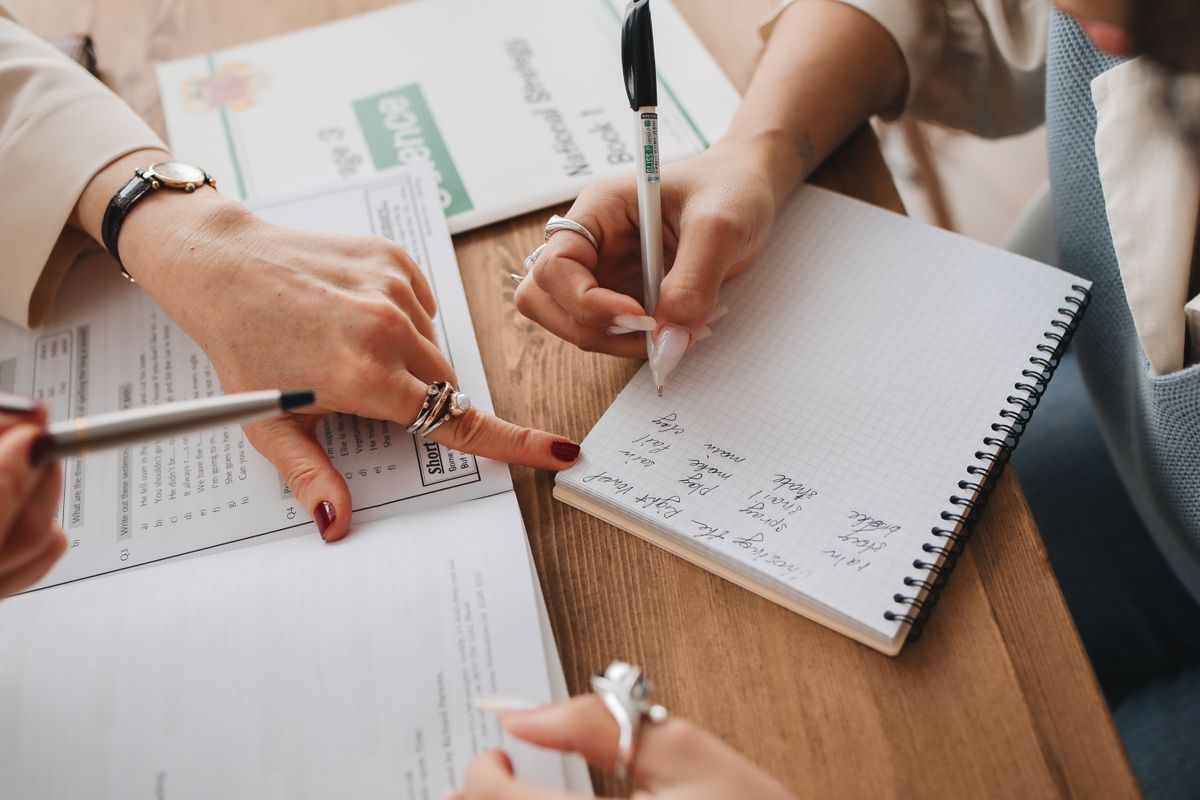
Practise one or two exam-style written questions each day, compare them against an answer key or marking scheme, and correct both content and presentation issues.
- 1Choose a representative question
Use a textbook task, teacher worksheet or official sample item.
- 2Set an appropriate timer
Use a realistic time for that question and its marks.
- 3Write without copying
Include the needed answer content, correct numbering and appropriate format.
- 4Check the answer objectively
Compare terminology, evidence, steps and clarity with a reliable scheme.
- 5Track one improvement
Next time focus on a specific habit such as numbering, units or explanation.
Do not practise presentation as handwriting alone; combine it with concept review and active answer-writing.
How do you check whether an answer is exam-ready?
Review answers with a checklist that prioritises correctness before surface neatness.
| Check | Ask yourself |
|---|---|
| Relevance | Did I answer all parts of the actual question? |
| Evidence | Did I include correct concepts, steps, reasons or examples? |
| Format | Is the paragraph, table, calculation or diagram appropriate? |
| Numbering | Are question numbers and subparts accurate? |
| Clarity | Could someone read each point without interpretation? |
| Time | Did I finish the response in a realistic time? |
Students can ask a teacher to review one handwritten response and identify the single most important improvement for the next attempt.
Which board exam answer-writing mistakes should you avoid?
The most costly presentation errors are those that obscure, omit or misidentify assessable content—not the absence of ornamental features.
If you tend to run out of time, stop rewriting already-clear answers merely to make the handwriting prettier. Prioritise accuracy, completion and checking.
How should students revise answer presentation one day before the exam?
Review the current sample paper’s directions and practise a few representative response formats; avoid overhauling your writing style just before the exam.
- 1Check exam logistics
Review reporting instructions, stationery rules and permitted materials from official sources.
- 2Review three answer formats
One short response, one longer theory response, and one numerical or diagram task as relevant.
- 3Scan your correction log
Look for repeated errors in headings, units, numbering, assumptions or labels.
- 4Prepare your writing supplies
Use permitted stationery you already find comfortable and carry required spares.
- 5Sleep and arrive prepared
Allow enough time to reach the exam location and start calmly.
What is the 2027 board exam answer-presentation checklist?
Before each mock test and the final examination, use a simple set of rules focused on assessable work.
| Before writing | While writing | Before submission |
|---|---|---|
| Read section and answer-book instructions | Use correct question and part numbers | Check missing answers and subparts |
| Notice command words and marks | Write legibly with reasonable spacing | Recheck formulas, units and signs |
| Choose the appropriate response format | Keep explanations relevant to the question | Inspect diagrams, labels and graphs |
| Budget time according to actual paper | Make corrections unambiguous | Ensure final answers are identifiable |
For CBSE 2027 preparation, the official Class 10 and Class 12 2026–27 sample papers are the starting point. Students from other boards should follow their own board’s published guidance.
Official sources and editorial freshness notes
The recommendations in this guide combine practical answer-writing methods from the provided article with official CBSE materials for the 2026–27 academic session.
- CBSE Academic: Class X sample question papers and marking schemes (2026–27).
- CBSE Academic: Class XII sample question papers and marking schemes (2026–27).
- CBSE: previous-year examination question papers.
- CBSE: board examination marking schemes archive.
Verification date: 8 October 2026. The article is written for students preparing for 2027 board examinations. Final paper instructions, board notices and any updated assessment details should be rechecked closer to the exams. No score increase, examiner behaviour or particular 2027 question is promised.
Frequently asked questions about neat board exam answers
Concise answers to common questions about board exam writing and presentation.
How can I present answers neatly in board exams?
Use readable handwriting, accurate question numbers, direct responses and sufficient spacing. Include required steps, examples, labels or diagrams according to the question and marking guidance.
Does neat handwriting give extra marks in CBSE board exams?
Neatness alone does not establish bonus marks. Clear handwriting helps make valid content legible, while marks are awarded according to the assessment requirements and applicable marking scheme.
Can I write board exam answers in bullet points?
Yes, when bullet points suit a list, comparison or explanation and the question instructions permit them. Use coherent prose where essay, letter, narrative or analytical writing is required.
Is underlining keywords compulsory in board exams?
No universal requirement has been established here. Underline sparingly only when allowed; using the correct terms and explanations matters more.
Should I draw diagrams in every Science answer?
No. Draw accurate and labelled diagrams when the question asks for them or a relevant diagram is an accepted part of the answer. Unnecessary drawings do not guarantee marks.
Do I need to box final answers in Maths?
Clearly identify the final result and include required calculations and units. A box may help readability where permitted, but it is not a substitute for correct method or content.
Which pen colour should I use for the CBSE 2027 exams?
Follow the stationery and ink instructions issued for your particular board exam. Do not assume a universal rule from general exam-tip articles.
How much space should I leave between board exam answers?
Leave enough space to distinguish answers and subparts while avoiding large empty areas that waste writing space and time. Follow any prescribed answer-book layout.
Should I answer short questions first or follow question order?
Follow the paper’s section and order instructions. If flexible order is permitted, choose a strategy you have tested in timed mock papers and number every answer precisely.
How can I improve handwriting speed before board exams?
Practise handwritten exam-style responses with a timer, focus on consistency and spacing, and compare your answers for completeness rather than trying to write decorative letters.
Where can I find CBSE sample papers for 2027 board exams?
CBSE Academic publishes the relevant 2026–27 subject-wise sample question papers and marking schemes for Class 10 and Class 12 at cbseacademic.nic.in.
How can I check whether my answers deserve full marks?
Compare each attempt with the applicable official marking scheme and teacher feedback. Check for missing ideas, incorrect methods, unclear labels and incomplete question parts; no presentation technique guarantees full marks.