
PRACTICAL EXAMS · VIVA VOCE · 2027 EXAM PREPARATION
How to Prepare for Practical Exams and Viva Voce Confidently: Expert Tips for Success
Know the format, practise procedures safely, organise records and learn to explain what you observed. This student-friendly guide helps you prepare for both hands-on assessment and oral questions.
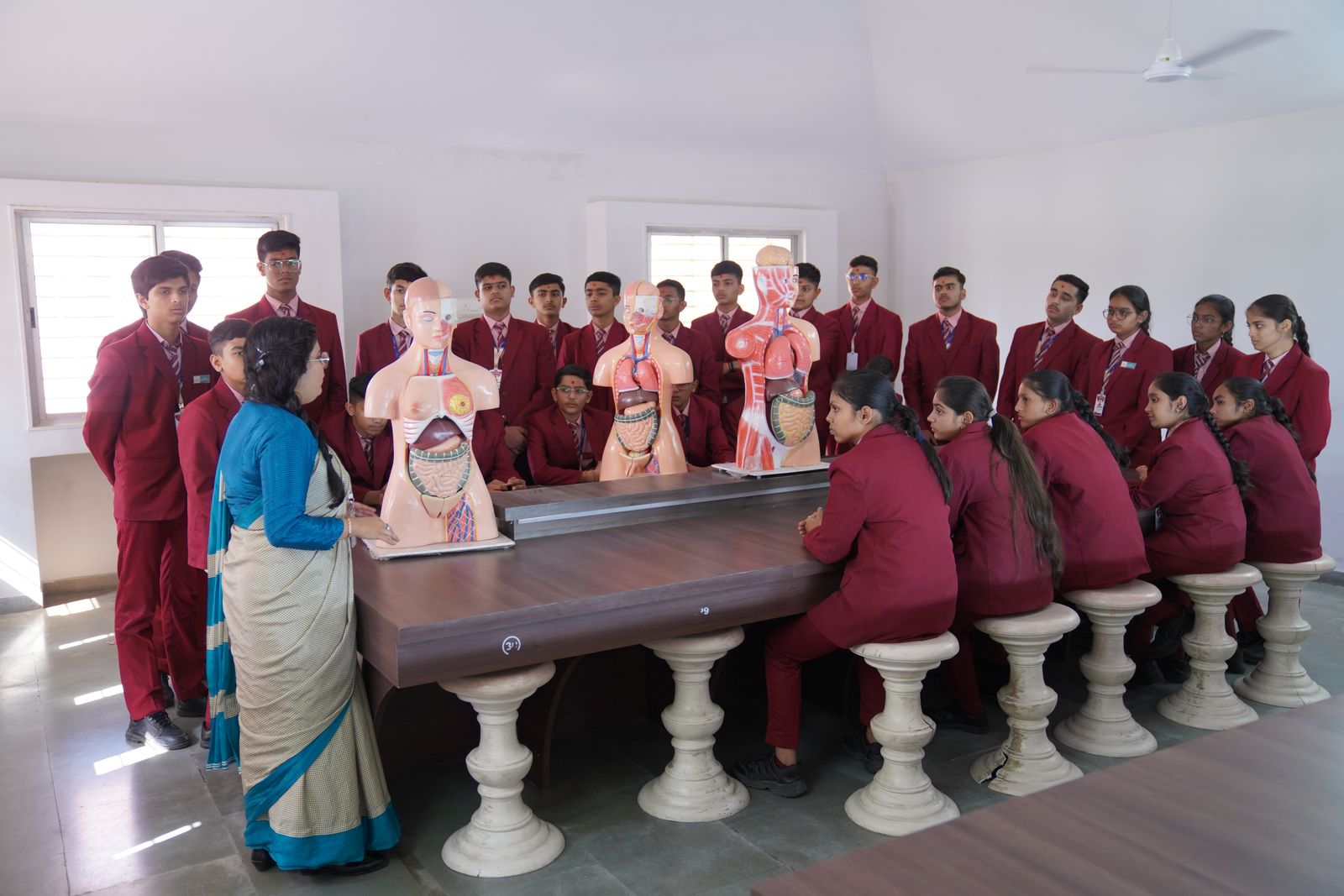
Students in Petlad, Gujarat working with an anatomy model in class; an illustrative real photograph, not a staged board examination.
How can students prepare confidently for a practical exam and viva?
Start with your subject’s official practical syllabus. Practise each required task, understand why every step is performed, complete your record honestly and rehearse explaining your observations aloud. A short mock practical and mock viva can reveal gaps before exam day.
| Prepare | Do this | How to check readiness |
|---|---|---|
| Assessment format | Check the current syllabus and school instructions | You know the tested activities, records and viva expectations |
| Practical skill | Perform the process safely under teacher supervision | You can name equipment, steps and precautions |
| Explanation | Say what you did and why | You can explain an observation in plain language |
| Record | Organise experiments and calculations | Your entries are complete and your own work |
| Mock assessment | Try a timed task and spoken questions | You can identify and correct weaknesses |
Choose one experiment today. Write its aim, principle, apparatus, steps, expected observations and two precautions. Then explain them aloud in under two minutes.
1. Understand the practical exam and viva voce format
A practical exam tests how you carry out a task; viva voce tests whether you can explain the related concepts, decisions and results. Your school, board, class and subject determine the exact assessment components.
For students preparing for the 2027 board-exam cycle, use the official CBSE 2026–27 curriculum as the starting point. In Class XII Chemistry, the published evaluation scheme totals 30 practical marks; this includes 4 marks for class record and viva. Do not apply these Chemistry figures to Physics, Biology, Computer Science or other subjects.
| Assessment component | What it may involve | Preparation action |
|---|---|---|
| Hands-on performance | Carrying out an experiment or demonstration | Practise the specific task with approved equipment |
| Practical record / project | Written observations, results or project work | Check requirements and keep records accurate |
| Viva voce | Spoken questions related to principles, apparatus and errors | Practise concise explanations aloud |
| Presentation / skill demonstration | Displaying, performing or explaining an artefact or process | Rehearse a short demonstration based on the subject rubric |
Your teacher’s current written instructions take precedence over generic online checklists.
2. Organise your practical record and revision materials
A well-organised record reduces avoidable last-minute searching. Assemble the approved practical list, record book, class notes, teacher instructions, relevant diagrams and a short sheet of viva terms. Check what you are actually required to bring.
- For each experiment, keep a one-page sheet: aim → principle → equipment → steps → observations → result → precautions.
- Recreate important diagrams and tables neatly with correct labels and units.
- Make a separate list of frequent errors or confusing observations for your teacher to clarify.
- Keep your file complete and authentic; copied or invented observations can undermine your ability to explain the experiment.
For organizing concepts rather than copying lengthy notes, see digital notes and mind-map techniques.
3. Make a practical-and-viva study plan
Divide revision into hands-on rehearsal and spoken explanation. A practical-only schedule may leave you unable to answer “why”; a viva-only schedule may leave you unsure how to operate equipment.
| Study day | Practical work | Viva practice |
|---|---|---|
| Day 1 | Read the approved activity list; audit your record | Explain the aim of each experiment |
| Day 2 | Rehearse a familiar practical safely | Name apparatus and measurements |
| Day 3 | Practise a weaker experiment with your teacher | Answer underlying-principle questions |
| Day 4 | Review observations, graphs and calculations | Explain the result and possible errors |
| Day 5 | Complete one supervised timed run-through | Try a five-question mock viva |
| Day 6 | Correct the mistakes recorded during practice | Repeat answers you could not explain |
| Day 7 | Light review, checklist and sufficient rest | Short confidence rehearsal; avoid cramming |
This is a sample seven-day routine, not an official timetable. Start earlier when your practical list is long and follow your school’s assessment date.
4. Learn the principle behind each practical step
Memorising an experiment’s steps is not enough if the examiner asks why a step matters. For each activity, connect the apparatus, variable or observation to the concept being tested.
- Ask “What is the experiment demonstrating?” before rehearsing the steps.
- For every instrument, know what it measures and which readings can be uncertain.
- For an experiment with variables, identify what is changed, measured and controlled.
- For an observation, know what the result supports—and what it does not prove.
A question such as “Why rinse a burette with the solution it will contain?” tests the idea that residual water could dilute that solution and affect measurements. Practise such explanations under the teacher’s supervision; never perform chemical experiments at home.
Build a stronger explanation habit with NCERT textbook study strategies.
5. Know lab safety and exam-day precautions
Correct safety behaviour is part of competent practical work. Follow the teacher’s specific instructions, wear prescribed protective gear and use laboratory equipment only under supervision.
- Inspect glassware or apparatus as instructed; report damaged equipment instead of improvising.
- Keep your workspace clear, label samples as directed and dispose of materials only by the lab’s procedure.
- Never taste or smell chemicals directly; do not handle live electrical setups or biological materials without permission.
- If something spills, breaks or behaves unexpectedly, stop and inform the examiner or lab teacher.
- For art, design, technology and other practicals, follow the corresponding equipment and tool-safety rules.
Finishing quickly is never a reason to bypass precautions. If a procedure is unclear, ask the supervising examiner for clarification.
6. Record observations, results and units correctly
A clear practical answer distinguishes what you measured from what you concluded. Keep values, units, working and results visible. Use tables when your teacher or format requires them.
| Entry | Correct approach | Common error |
|---|---|---|
| Measurement | Write a value with the appropriate unit and justified precision | Omitting units or inventing extra decimal places |
| Observation | Describe the actual colour, reading or change | Writing the expected result instead of what happened |
| Calculation | Show formula, substitution and final answer | Jumping directly to a number without context |
| Result | Relate the observation to the aim | Making a stronger claim than the data support |
| Precautions | Mention experiment-specific safety or accuracy steps | Copying generic precautions that do not apply |
If your result differs from the expected value, report the actual reading honestly and discuss possible causes when asked.
7. Use a three-part method to answer viva questions
Aim for answer → reason → example or observation. Give the direct answer first; add detail only when needed. That is often clearer than a memorised paragraph.
| Examiner asks | Concise first answer | Useful follow-up |
|---|---|---|
| What is the aim of this experiment? | To investigate or measure [the stated variable]. | Explain which reading addresses the aim |
| Why use this apparatus? | It measures or controls [quantity]. | Mention appropriate range or limitations |
| What did you observe? | State the actual reading or change. | Explain what the observation suggests |
| What if the result differs? | I would first check the setup and readings. | Describe a realistic source of error |

Use correct terminology, but speak in your own words. Avoid making up a result to sound confident.
8. Practise common viva questions by subject
Prepare questions linked to the specific activities on your list. The following are illustrative practice prompts, not a prediction of your examiner’s actual questions.
| Subject | Example viva prompt | What to prepare |
|---|---|---|
| Physics | What does the least count of an instrument mean? | Smallest scale increment or resolution; relevant uncertainty |
| Chemistry | Why do we rinse a measuring device with the solution used in it? | Effects of contamination or dilution in that setup |
| Biology | What feature identifies this specimen or model? | Correct observable features and biological function |
| Computer Science | What does this part of your program do? | Input, processing, output, and one test case |
| Art / Design | Why did you choose this technique or material? | Aesthetic or technical reasoning for the stated brief |
| Geography / Project | How did you collect this observation? | Method, data source, reliability and limitations |
For Physics and Chemistry, revise only the methods and apparatus included in your current school-approved list; subjects differ in detail and marking.
9. Run a mock viva with a teacher or study partner
A mock viva gives you a safe place to hear the question, organise an explanation and notice when you are guessing. Ask the partner to choose questions randomly from your own practical list.
- Give your partner the practical syllabus and a short question bank.
- Answer each question aloud without reading.
- Ask the partner to follow with “why?”, “how do you know?” or “what could go wrong?”.
- Take feedback on content accuracy, not merely speaking fluency.
- Repeat the questions you missed after correcting the underlying concept.

Keep each round short so students can focus on actionable feedback. For an effective peer session, see group study and online collaboration tips.
10. Simulate the actual practical with the right supervision
Practise a sequence rather than isolated steps: read the task, check apparatus, set up, conduct the procedure, record observations, calculate where needed and tidy the workstation safely.
- Do one complete supervised rehearsal under a reasonable time limit.
- Check whether you can recover calmly if a reading is unexpected.
- Rehearse how to explain your result and limitations.
- Note which setup or observation takes you the longest and address it next time.
Experiments involving chemicals, heat, electricity, sharp tools or biological material belong in approved supervised settings. Written planning and verbal explanations can be practised at home.
11. Diagnose your weak areas instead of rereading everything
After a rehearsal, label each problem as concept, procedure, observation, calculation, communication or safety. Then choose a repair task matched to that weakness.
| If the problem was… | Next action |
|---|---|
| Forgetting the principle | Explain the why in one sentence, then check the textbook |
| Incorrect setup | Repeat the equipment sequence with a teacher |
| Inaccurate observation | Compare actual readings and review instrument use |
| Calculation error | Rework one example with units and significant figures |
| Unclear viva answer | Practise a direct answer with one reason |
| Safety uncertainty | Ask for the official procedure before performing the task |
Focused corrections are often more useful than repeating the entire practical record without feedback.
12. Handle nerves before and during viva voce
Feeling nervous before an oral examination is common. Confidence can come from preparation and from knowing how to respond calmly when the question is unfamiliar.
- Before entering, review a brief checklist rather than cramming a whole textbook.
- Listen to the entire question and ask politely for it to be repeated if needed.
- Take a short moment to organise your answer.
- If unsure, state the part you know and explain it carefully without inventing facts.
- Speak clearly and at a natural pace; eye contact can be respectful without being forced.
“I’m not certain of the exact value. I can explain the principle and how I would check the reading.” Be truthful, and respond to any follow-up guidance from the examiner.
Students dealing with persistent exam anxiety may also find practical ways to manage exam stress useful.
13. Common mistakes in practical exams and how to avoid them
| Mistake | Better approach |
|---|---|
| Learning procedure words only | Link each step to its purpose and concept |
| Ignoring the practical record until the last day | Check completeness and accuracy in advance |
| Rushing the setup | Read the task and follow the specified sequence |
| Copying expected observations | Write actual readings and explain differences |
| Skipping safety precautions | Follow equipment and material rules at every step |
| Using unexplained formulas | Name the quantity, substitute values and show units |
| Hiding uncertainty in viva | Acknowledge what you do and do not know |
| Memorising very long speeches | Answer directly, then explain only as needed |
14. What to do the day before your practical exam
The day before is best used for a calm final check, not trying a new complex experiment for the first time.
- Confirm the examination date, reporting instructions and permitted materials.
- Review your practical file and syllabus checklist.
- Speak through the principle and observation for three commonly tested activities.
- Check the required school ID, stationery or approved items.
- Get sufficient sleep and plan your travel or arrival time.
Avoid bringing unauthorized devices, notes or materials into the exam setting. Exact rules come from your institution.
15. Exam-day checklist for practicals and viva voce
| Before the practical | During the practical | Before leaving |
|---|---|---|
| Check instructions and approved materials | Read aim, task and precautions | Submit record/work only as instructed |
| Arrive according to school reporting time | Record authentic observations and units | Confirm required answer sheets are complete |
| Know your basic apparatus names | Keep your workspace and conduct safe | Return equipment and clear the space |
| Review a few key concepts calmly | Answer viva questions clearly and honestly | Follow the examiner’s final instructions |
No preparation technique guarantees full marks. The strongest preparation combines correct subject knowledge, supervised skill practice, accurate observations, good records and clear explanations.
16. A 30-minute daily viva-preparation routine
When the practical is approaching, a focused short routine may be more manageable than long, unfocused revision. Adjust the time to the number of experiments and your school schedule.
| Minutes | Task | Outcome |
|---|---|---|
| 0–5 | Recall one experiment’s aim and underlying principle | Find theory gaps |
| 5–12 | Review its apparatus, measurements and safety points | Strengthen procedure understanding |
| 12–20 | Answer four viva questions aloud | Practise concise explanations |
| 20–27 | Review a real result, diagram or sample calculation | Practise interpreting evidence |
| 27–30 | Record one doubt to resolve with your teacher | Plan the next improvement |
Add hands-on supervised sessions on days when the school provides laboratory practice. A sustainable daily study routine can help you fit revision around your other subjects.
17. Practical confidence comes from knowing what you are doing
Preparing for practical exams and viva voce is not about memorising the longest list of probable questions. It means understanding the experiment, practising safe technique, documenting real observations and explaining your decisions clearly.
Start with the experiment you find hardest. Identify its purpose, ask your teacher about the step you cannot explain and rehearse a short mock viva. Small, accurate improvements are more useful than last-minute panic.
Official and supporting learning resources
- CBSE 2026–27 curriculum and syllabus
- CBSE 2026–27 Class XII Chemistry practical evaluation scheme (PDF)
- CBSE 2026–27 Class XII Physics curriculum (PDF)
- CBSE 2026–27 Class XII sample papers and marking schemes (written-paper practice)
- Official NCERT textbooks
CBSE sample papers are helpful for written/theory questions, but they do not replace the practical syllabus or the school’s specific oral-assessment instructions.
Frequently asked questions
What is the difference between a practical exam and viva voce?
A practical exam assesses how you perform a task or experiment. Viva voce is an oral assessment of the principles, methods, observations or decisions behind that work.
How can I prepare for a practical exam in one week?
Check the approved activity list, organise records, review each procedure, do supervised rehearsals and practise brief spoken explanations. Use a realistic seven-day plan rather than trying to learn everything the last night.
What questions are asked in a science practical viva?
Questions usually relate to the approved experiment, its aim, apparatus, principle, procedure, observations, result and precautions. Your subject and examiner determine the actual questions.
Is the viva voce marking pattern the same in all CBSE subjects?
No. Marking components vary by subject. For example, the 2026–27 CBSE Class XII Chemistry practical scheme includes class record and viva together for four marks within a 30-mark practical total.
How do I answer viva questions confidently?
Listen, give a short direct answer, explain the reason, and refer to the experiment when useful. Speaking clearly is valuable, but factual accuracy matters more than sounding confident.
What should I say if I do not know a viva answer?
Do not fabricate. Politely acknowledge the uncertainty, state any correct related concept you know and respond to the examiner’s follow-up question.
Do I need to memorise the entire practical file?
No. Know the approved experiments well enough to explain their objective, underlying concept, main steps, real observations, possible errors and precautions. Definitions and key values still require accurate recall.
How can I practise lab experiments safely at home?
Do not perform chemical, electrical or other potentially hazardous experiments without appropriate supervised facilities. At home you can review diagrams, procedure cards and viva questions.
How many mock viva sessions should I practise?
There is no fixed universal number. Practise enough short sessions to identify and correct weak answers, preferably with feedback from a teacher or reliable study partner.
How should I prepare for a Computer Science practical viva?
Practise explaining your code or task, its input and output, important logic, error handling and one or two test cases according to your school’s current syllabus.
Can I score well if my final experiment result is not perfect?
Assessment rules vary. Clear technique, real observations, sound reasoning and correct records may still be relevant, but do not assume partial marks; follow the subject-specific rubric.
What should I do on the morning of the viva?
Follow reporting instructions, bring permitted materials, review key principles briefly, avoid last-minute cramming and be ready to explain what you actually did.