
Board exam preparation · Study routine
Daily Study Routines of Board Toppers You Can Follow in 2026
There is no single routine followed by every board topper. But high-performing students commonly use a predictable system: fixed study blocks, active recall, spaced revision, weekly mock practice, mistake correction, sleep discipline and fewer distractions.
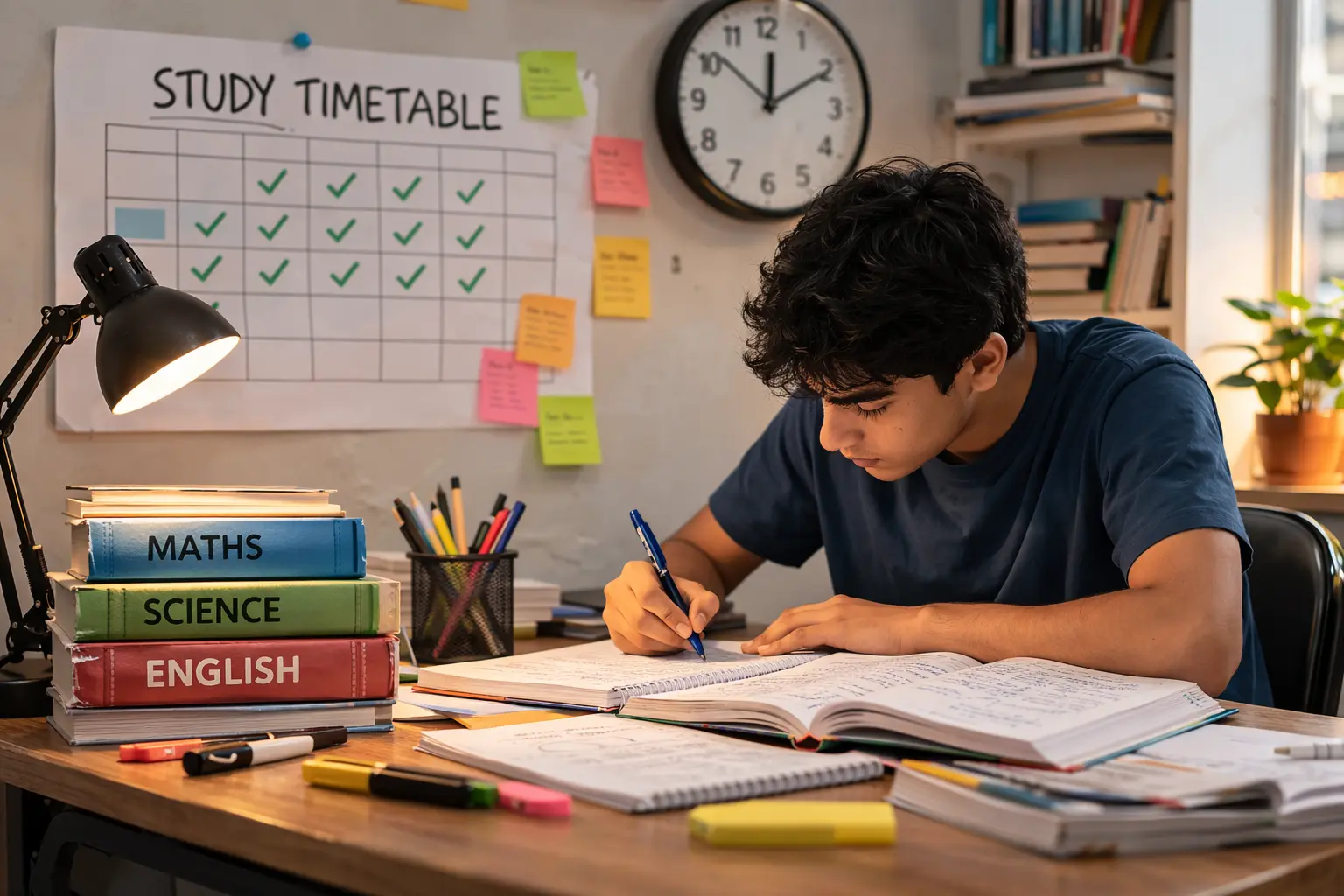
Board preparation becomes easier when students know what to learn, recall, practise, review and correct every day.
What is the best daily study routine for board exams?
A strong daily study routine for board exams combines fixed study time, active recall, targeted practice, planned revision, mock-test review and proper sleep. The goal is not to study all day; the goal is to study with a repeatable system.
Many students lose time because they decide what to study only after sitting down. High-performing students usually reduce that confusion by planning the day in blocks and keeping revision non-negotiable.
| Routine element | Practical method | Why it helps |
|---|---|---|
| Warm-up | Flashcards, yesterday’s notes or two easy questions | Reduces starting resistance and activates recall |
| Concept block | 60-90 minutes of focused learning | Builds understanding before practice |
| Practice block | 45-60 minutes of questions | Turns knowledge into exam performance |
| Revision block | 30 minutes of active recall | Prevents forgetting and improves confidence |
| Mock practice | Timed section or paper every week | Builds speed, accuracy and pressure handling |
The Mass Graduates study framework: Learn, Recall, Practice, Review, Correct, Repeat
Mass Graduates recommends a simple cycle for board students: Learn → Recall → Practice → Review → Correct → Repeat. This is a practical study framework, not a scientific law or a guarantee of marks.
Learn
Understand the concept from the textbook, teacher notes or a trusted class resource.
Recall
Close the book and write or explain what you remember without checking the answer first.
Practice
Solve board-style questions, previous-year questions or textbook exercises.
Review
Check what was correct, what was slow and what was unclear.
Correct
Add mistakes to a logbook and revise the weak concept before moving ahead.
Repeat
Revisit the same topic after a gap so the memory becomes stronger.
How should board students start the study day?
A practical morning routine starts with a short mental warm-up before heavy learning. This helps the student enter study mode without wasting the first hour.
A simple 15-20 minute warm-up
- Review 5 to 10 flashcards.
- Scan the previous day’s notes.
- Solve 2 to 3 very easy questions.
- Refresh one quick mind map or formula list.
This is not about finishing a chapter. It is about reducing friction. Once the brain has started recalling familiar material, the first serious study block becomes easier.
How should students divide their study time?
Students should divide study time into clear blocks: one block for concepts, one for practice, one for revision and short fixed breaks between them.
| Block | Suggested duration | Best use |
|---|---|---|
| Concept block | 60-90 minutes | Learning theory, examples and textbook explanations |
| Practice block | 45-60 minutes | Solving questions without checking answers immediately |
| Revision block | 30 minutes | Recall, formula review, diagrams and key points |
| Short break | 5-10 minutes | Stretching, walking, water or breathing reset |
| Long break | 45-60 minutes | Food, rest and mental recovery |
When the schedule is mood-driven, focus fails easily. When it is block-driven, the routine needs less daily decision-making.
Should board students study every subject daily?
Most students do not need to study every subject every day. A better approach is to choose subjects based on weightage, weakness, deadline and exam distance.
Many students avoid weak subjects because they feel uncomfortable. A stronger method is to give the weak subject a smaller but fixed block every day until the fear reduces.
Why is active recall better than only reading notes?
Active recall forces the student to retrieve information from memory. For board preparation, this is more useful than only rereading because exams also require recall, writing and application.
- Self-testing without looking at the answer.
- Teaching the concept aloud.
- Writing memory maps from recall.
- Doing timed practice questions.
- Solving previous-year papers and checking mistakes.
Reading notes can help understanding, but it may also create a false feeling of preparation. Students should test themselves early, find the gap and correct it.
How often should students revise a chapter?
A practical revision cycle is to revisit a new topic on the same day, again after about 7 days and again after about 30 days. Difficult chapters may need shorter revision gaps.
Same-day revision
Locks the first layer of memory before the topic fades.
Revision after 7 days
Strengthens recall and exposes what was only partly understood.
Revision after 30 days
Consolidates the topic for exam recall and reduces last-minute panic.
This is why well-prepared students often look calmer before exams. They are not revising everything from zero; they have built memory gradually.
How should students use mock tests and previous-year papers?
Mock tests and previous-year papers should be used for practice, analysis and correction. Attempting a paper is only half the work; reviewing mistakes is where improvement happens.
Weekly mock-test workflow
- Attempt one timed mock test or timed section.
- Check the answer sheet critically.
- Identify which questions wasted time.
- Mark whether each mistake was conceptual, careless or time-related.
- Revise the weak concept and retest similar questions.
| After the mock test | What to check | Action |
|---|---|---|
| Low score | Was the problem concept, speed or presentation? | Fix one cause at a time |
| Repeated mistake | Is the same chapter causing errors? | Add it to the revision cycle |
| Slow question | Did the method take too long? | Learn a shorter method or skip strategy |
| Silly mistake | Was the answer lost due to carelessness? | Create a final checking habit |
How should students set up a distraction-free study environment?
A predictable study environment reduces friction. Students should keep the desk simple, use limited resources and keep the phone out of reach during deep-study blocks.
| Environment rule | Better practice |
|---|---|
| Desk | Use one fixed study desk or one fixed study corner. |
| Materials | Keep only the textbook, notebook and current practice material nearby. |
| Phone | Keep it out of reach during study blocks. |
| Resources | Use pre-decided resources instead of switching books and apps daily. |
| Notebook system | Maintain one binder, notebook or digital note system for revision. |
Can AI tools help with board exam preparation?
AI tools can help board students when used for explanation, quiz generation, self-testing, mistake analysis and study planning. They should not replace textbooks, teachers, official material or actual problem-solving.
| Good use of AI | Bad use of AI |
|---|---|
| Ask for a simple explanation of a difficult concept | Copying answers without understanding |
| Generate practice questions for revision | Trusting unverified answers blindly |
| Create flashcards or quick quizzes | Replacing textbook study completely |
| Check why a solution step is wrong | Avoiding written practice |
| Plan revision blocks for the week | Using too many apps without consistency |
Responsible AI workflow: Learn → Recall → Practice → Check → Correct → Retest. AI should support this cycle, not bypass it.
What should students do in the evening?
The evening routine should focus on light revision, mistake review and preparing tomorrow’s tasks. It is usually not the best time to start the hardest new topic.
- Light revision of the day’s learning.
- Arranging tomorrow’s study tasks.
- Solving 4 to 5 mixed questions.
- Reviewing mistakes made that day.
- Avoiding heavy mental stimulation before sleep.
Sleep matters for learning
Sleep supports attention, memory and daily performance. CDC sleep guidance notes that good sleep habits include consistent sleep timing and turning off electronic devices before bedtime.
For many teenagers, 8-10 hours is generally recommended by sleep-health guidance. Students should avoid repeated late-night cramming because it can reduce next-day focus.
What are the common mistakes students should avoid?
The biggest routine mistakes are studying only when motivated, avoiding weak chapters, rereading without testing and taking mock tests without analysing mistakes.
| Mistake | Why it hurts preparation | Better action |
|---|---|---|
| Only reading notes | Creates a false sense of learning | Use active recall and written practice |
| Avoiding weak subjects | Weakness grows near the exam | Give the weak topic a fixed daily block |
| Too many resources | Creates confusion and unfinished study | Use textbook plus limited practice material |
| No mistake log | Same errors repeat in tests | Track and retest every major mistake |
| Random breaks | Breaks become distractions | Use short fixed breaks without scrolling |
A realistic topper-style daily timetable
This timetable is only a model. Students should adjust it based on school hours, tuition, travel, health and personal energy.
| Time | Routine | Purpose |
|---|---|---|
| Morning | 15-20 minute warm-up + one concept block | Start the day with clarity |
| After school / afternoon | Practice block with questions | Convert learning into scoring ability |
| Evening | Revision block + mistake correction | Strengthen memory and fix gaps |
| Night | Light review + plan tomorrow | Close the day without panic |
| Weekly | Timed mock test or previous-paper practice | Train exam pressure |
Editorial transparency and useful sources
This article is prepared by Mass Graduates as a practical student guide. It combines the supplied original blog ideas with safer wording, answer-first structure, study-method explanations and source-supported guidance where factual claims need support.
Frequently asked questions
How many hours should board students study daily?
There is no fixed number for every student. A practical routine focuses on consistent blocks, revision and practice quality rather than only counting hours.
What should I study first each day?
Start with a short warm-up, then study the most important, urgent or weakest topic while your energy is high.
Should I study every subject daily?
Not always. It is usually better to prioritise high-weightage chapters, weak areas and upcoming tests instead of touching every subject randomly.
How often should I revise a chapter?
A practical method is to revise on the same day, again after about 7 days and again after about 30 days. Difficult chapters may need shorter gaps.
Is active recall useful for board exams?
Yes. Active recall helps students practise retrieving information, which is closer to exam performance than only rereading notes.
Are mock tests necessary for board preparation?
Mock tests are highly useful because they train speed, accuracy, time management and exam pressure. The review after the mock is as important as the test itself.
How should I use previous-year papers?
Use previous-year papers to understand question patterns, practise time management and identify repeated weak areas. Do not only read the answers; attempt the questions first.
Can AI tools help with board preparation?
Yes, if used carefully. AI tools can explain concepts, generate quizzes and help analyse mistakes, but they should not replace textbooks, teachers or verified answers.
What should I do if I am weak in a subject?
Give the weak subject a small fixed daily block, start from basic concepts, solve easy questions first and track every mistake until the fear reduces.
How important is sleep for board exam preparation?
Sleep is important because it supports attention, memory and daily performance. A stable sleep schedule is usually better than repeated late-night cramming.
Final takeaway
A strong board-exam routine is not dramatic. It is repeatable. Learn the concept, recall it without looking, practise questions, review mistakes, correct them and repeat the cycle. That system is what students can realistically follow every day.