Study techniques · Learning strategies
Visual vs Auditory Learning: How Students Can Find Their Best Learning Style
Prefer mind maps or spoken explanations? Explore visual and auditory study techniques, compare which ones help you remember and apply lessons, and build a study routine that works for your subjects.

Use pictures, listening and recall to turn lessons into understanding.
Visual vs auditory learning: which study method is best?
Quick answer: Visual learning uses diagrams, charts, pictures and written layouts; auditory learning uses spoken explanations, listening and discussion. Students can benefit from either method—or both—depending on the topic and task. The best method is the one that helps you understand the material and answer questions accurately later.
Important distinction: Preferring pictures or audio does not mean you have one fixed learning style. Research does not show that labelling students as visual or auditory learners and matching all teaching to the label improves achievement. Try different methods, then check what you can recall.
| Student question | Practical answer |
|---|---|
| How do I study a process? | Draw a labelled diagram or flowchart, explain each step aloud, then reproduce it without notes. |
| How do I revise a definition? | Read the exact textbook definition, explain it in your own words, and test written recall. |
| Which method should I choose? | Choose a format suited to the subject and compare your practice-test results—not just which activity feels easier. |
| Can I combine both? | Yes. A narrated diagram followed by a short self-test is a practical combination. |
What is visual learning?
Visual learning means presenting or studying information through what you see: diagrams, illustrations, charts, timelines, maps, written layouts or demonstrations.
For example, a Class 10 student revising the circulatory system may find a labelled heart diagram easier to interpret than a lengthy verbal description. A Class 12 student might use a graph to understand how a physical quantity changes. These are useful choices because the information itself has a visual structure.
Common visual study activities
Place a central idea in the middle and draw branches showing related points.
Use arrows to connect stages of a process, reaction or sequence.
Organise dates, trends or numerical relationships so the pattern is visible.
Label the important parts of a concept and test the labels from memory.
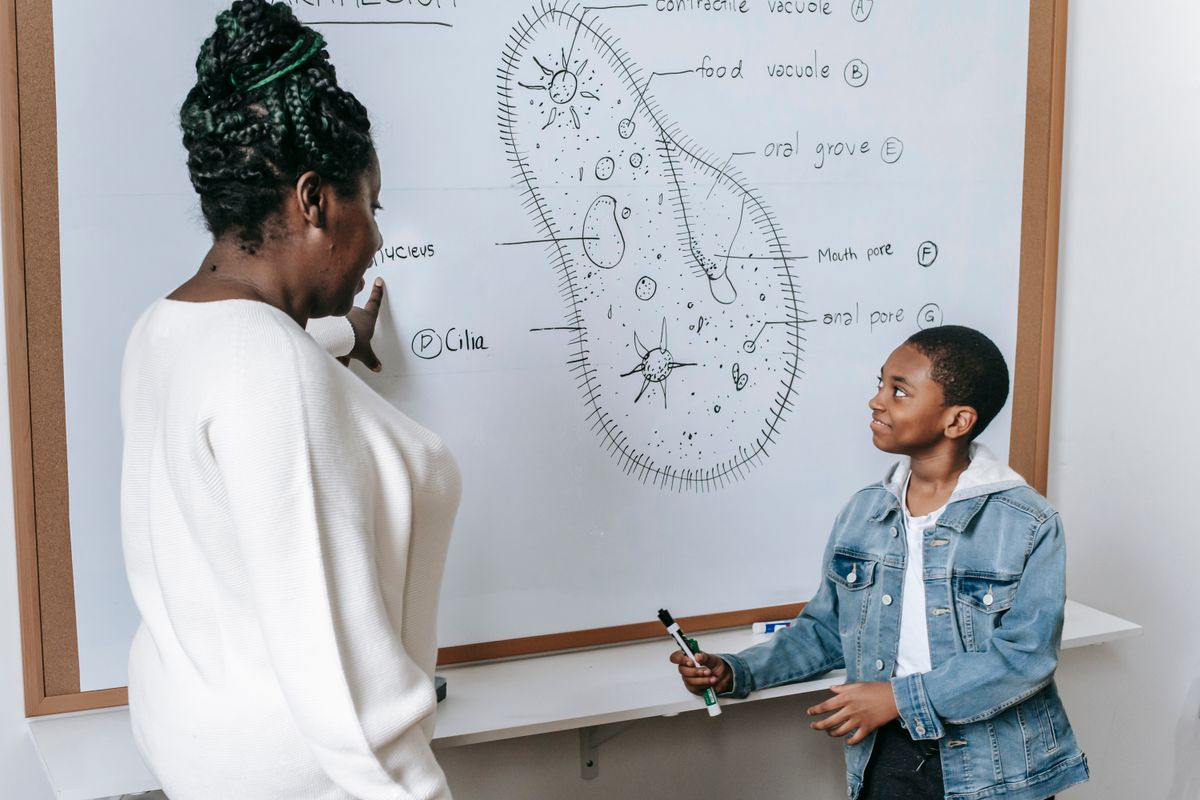
Remember: A colourful page is not automatically a better study resource. After looking at the diagram, hide it and redraw or explain the key ideas to test what you learned.
What is auditory learning?
Auditory learning uses sound and spoken language to explain or rehearse ideas. Examples include listening to a lesson, reading aloud, asking questions, joining a discussion or explaining a topic in your own voice.
If a complicated English passage becomes clearer after you hear it read aloud, or a science concept becomes clearer after discussing it with a teacher, sound is serving a useful purpose. Audio works especially well for practising pronunciation, spoken language, discussion and explanation.
Common auditory study activities
Teach the topic without reading from the textbook.
Work with a classmate to test understanding rather than only listening passively.
Record your own explanation and replay it to notice omitted points.
Listen for sentence structure, pronunciation and meaning.

Simply replaying a recording many times may feel familiar without proving that you can write the answer independently. Follow listening with retrieval practice.
Visual vs auditory learning: key differences
Neither method is universally superior. The useful difference is how the information is represented and what you do with it afterward.
| Aspect | Visual approach | Auditory approach |
|---|---|---|
| Main input | Diagrams, pictures, written layout and demonstrations | Speech, listening, oral explanation and discussion |
| Best example | Reading a graph showing a trend | Hearing how to pronounce an English word |
| Typical tools | Mind maps, timelines, diagrams, visual flashcards | Teacher explanations, voice notes, podcasts, study discussions |
| Active task | Close the book and redraw or label the figure | Close the notes and explain the idea aloud |
| Common mistake | Decorating notes without understanding | Listening repeatedly without testing recall |
| Better result check | Label a fresh diagram or solve a related question | Write a summary or solve the same type of question |
For board exams: Final answers are often written, drawn or calculated. Practise those output skills even if you first learned the topic through a video, lecture or discussion.
How can you recognise your study preferences?
Preferences are clues about what keeps you engaged, not a test of what your brain can learn. You might enjoy colourful biology drawings, spoken history explanations, and hands-on mathematics questions in the same week.
Try a flowchart when the lesson includes a sequence or relationship.
Explain your reasoning to a friend and invite questions.
Reserve colours for a few clear meanings: definition, example, exception.
Use it for difficult passages, then answer questions without the text.
Do I need a learning-style quiz? Not to decide how you must study. A quiz may describe preferences, but it is not a reliable diagnosis of the teaching method that will maximise your marks. Use real recall and application tests instead.
Practical study techniques using visuals
Visual techniques work best when a chart, picture or diagram reveals relationships—and you then use that representation to answer questions.
- 1Convert paragraphs into a flowchart
For Biology, turn a sequence such as digestion or photosynthesis into boxes connected with arrows.
- 2Use a two-column comparison
In Chemistry, compare related reactions or definitions with only the distinctions that matter.
- 3Draw timelines and cause-effect maps
In History, connect events with dates, causes and consequences rather than memorising an isolated list.
- 4Sketch a solution before calculating
In Physics, label the known quantities on a diagram and identify the relationship you need.
- 5Make tested visual flashcards
Put a labelled diagram on one side and a blank version on the other; reconstruct the missing labels.
Example: For the water cycle, draw evaporation → condensation → precipitation → collection. Hide the sequence and reproduce it with one explanation per stage.

Practical study techniques using audio
Listening is most productive when you actively process what you hear rather than leaving a lecture or podcast playing in the background.
- 1Use the teach-back method
Listen to a short explanation, pause, and explain the key idea without looking at the notes.
- 2Record brief topic summaries
Make a one-minute audio explanation of a definition, law, event or process. Check it against the textbook.
- 3Discuss with a study partner
Ask each other why an answer is correct, not merely what the answer is.
- 4Read for meaning
Read literature or tricky instructions aloud, paying attention to punctuation and reasoning.
- 5Create a question-and-answer audio drill
Record questions with a pause before the answer so you have to retrieve it first.
Example: After a History lesson, record a 60-second explanation of why an event occurred. Then write a five-mark answer without replaying the recording.

How to find the methods that actually work for you
Use a small study experiment: compare the quality of your answers after visual and auditory practice. Judge the result from your performance, not only how comfortable studying felt.
Try the following experiment over a few days. It is a personal study check, not a scientific test of a fixed learning type.
Pick two similar sections from your Class 11 or 12 syllabus
For example, two biology processes of similar difficulty. Decide how you will test both before studying.
Study the first section for about 12–15 minutes
Use a diagram, annotated notes or a concise flowchart. Avoid checking the answers during the test.
Study the second section for the same amount of time
Listen to a short explanation, then pause and teach it back. On another day, switch which method you use first.
Answer matched questions with your notes closed
Mark accuracy, missing keywords, time taken and how clearly you can explain the concept.
Do another short test one or two days later
Look for methods that help you recall and apply the content after a delay, then adjust by subject.
Fair comparison: Topics may differ in difficulty, so repeat the exercise and switch formats before drawing conclusions. If diagrams help with graphs but listening helps with pronunciation, that is a useful task-specific finding.
How to combine visual and auditory learning
Combining formats can be helpful when each contributes something meaningful. A good sequence is see or listen → explain → practise → check, rather than watching and listening passively.
Watch or draw a labelled diagram and explain what each arrow means.
Pause after a short clip; describe the idea without replaying the teacher.
One person explains; the other draws the links and challenges any gaps.
Speak through a passage, then answer written comprehension questions.
| Board-exam task | Useful mixed approach |
|---|---|
| Biology process | Draw and label the process, explain each stage aloud, then answer a question. |
| Mathematics theorem | Study the diagram, talk through the proof, then solve a new problem independently. |
| Chemistry reaction | View the equation, explain the conditions aloud, then write it from memory. |
| English literature | Read a passage aloud, note key themes, then write an original response. |
Best visual and auditory study methods by subject
Select a study method that represents the information clearly and prepares you for the answer format required by the exam.
| Subject | Useful visual method | Useful oral or listening method | Essential independent practice |
|---|---|---|---|
| Mathematics | Graphs, geometry sketches and worked steps | Explain why a solution step is valid | Solve unfamiliar questions |
| Physics | Ray diagrams, circuit diagrams, force diagrams | Explain the law and meaning of variables | Write formulas and solve numerical problems |
| Chemistry | Reaction pathways, periodic trends, labelled apparatus | Describe reaction conditions or mechanisms | Balance equations and answer application questions |
| Biology | Labelled diagrams, cycles and process maps | Teach back functions, stages and definitions | Redraw diagrams and write key-term answers |
| English | Character charts and story timelines | Read aloud, discuss themes and practise pronunciation | Write original paragraphs and comprehension answers |
| History / social science | Timelines, maps and cause-effect charts | Discuss causes, consequences and arguments | Write organised, evidence-based answers |
For CBSE students, check textbook terminology through the NCERT textbook portal. For state boards, use the prescribed textbooks and relevant marking guidance.
What does research actually say about learning styles?
Students have preferences, but there is insufficient high-quality evidence that teaching each child only through a diagnosed visual or auditory learning style improves academic achievement.
A review by Pashler and colleagues analysed the evidence behind matching instruction to learning-style categories and did not find adequate support for that approach. The Education Endowment Foundation also cautions against labelling students or limiting their activities based on a supposed single style.
This does not mean that diagrams or spoken explanations are useless. It means the format should suit the learning objective, and students should have opportunities to learn through different approaches.
Evidence-based priority: A major research review found strong general support for practice testing and distributed practice. Whichever format you choose, add closed-book recall and spaced revision. See the Association for Psychological Science review.
Learning should also account for access needs: captions, readable text, audio versions and accessible diagrams can make study materials more usable. Those accommodations should not be confused with fixed learning-style labels.
Study habits that matter more than a learning-style label
Strong study routines depend on understanding, practice and feedback. You can use these with a chart, a lesson recording or a textbook.
Put your notes away and write, draw, explain or solve the answer from memory.
Return to the same concept across different days; review difficult items more often.
Study a correct solution, then attempt a comparable problem independently.
Ask why each step, relationship or detail matters.
Compare your answer with the textbook or marking guide and correct missing points.
Use the kind of questions and written output you will face in the exam.
For a structured break-and-recall schedule, read the Mass Graduates guide to Pomodoro and Mind Gap study techniques.
Digital and offline tools students can use
Tools are useful only when they make learning clearer or allow you to practise. Free paper and pencil often work just as well as a complicated app.
| Method | Digital option | Low-tech alternative | What to test |
|---|---|---|---|
| Visual maps | Canva diagrams or whiteboards | A4 paper with coloured pens | Can you reconstruct the idea without the map? |
| Visual flashcards | A flashcard application with image prompts | Index cards with a diagram on one side | Can you name the part or explain its role? |
| Audio recall | Phone voice recorder | Teach the concept to a partner | Can you reproduce the explanation without prompts? |
| Dual-format notes | Video lesson with captions and a short hand-drawn chart | Teacher notes plus a hand-drawn flowchart | Can you solve a textbook question independently? |
| Tracking progress | Simple note-taking or spreadsheet app | Notebook error log | Are your repeated mistakes decreasing? |
When recording a class or another person, get permission first. Avoid uploading private school material or classmates’ voices to services without consent.
A 30-minute visual and auditory study routine
This example balances different ways of engaging with material and keeps independent recall at the centre. Adjust the time according to difficulty and your attention level.
| Time | Action | Reason |
|---|---|---|
| 0–5 min | Choose one syllabus objective and check previous mistakes. | Make the goal specific. |
| 5–12 min | Study a diagram, brief text or clear teacher explanation. | Build understanding. |
| 12–18 min | Explain the concept aloud or make a small concept map. | Organise your reasoning. |
| 18–26 min | Close the material and answer questions, label a diagram or solve a problem. | Practise retrieval and application. |
| 26–30 min | Check mistakes and schedule the next short review. | Use feedback to plan revision. |
If a longer session works for you, take a reasonable break and then change to another topic or question type. Study quality matters more than the number of hours claimed.
A one-week plan to compare and improve methods
Use this sample plan to experiment, combine useful approaches and build a repeatable revision habit.
| Day | Activity | What to measure |
|---|---|---|
| Monday | Make a diagram or mind map for a topic. | Can you reproduce the key relationships? |
| Tuesday | Learn a similar topic through a spoken explanation. | Can you explain it without listening again? |
| Wednesday | Answer short written questions on both topics. | Accuracy and missing points. |
| Thursday | Use both a diagram and a teach-back session on a difficult topic. | Understanding of steps and connections. |
| Friday | Attempt textbook or board-style questions. | Whether you can apply what you studied. |
| Saturday | Review your mistakes and test again without notes. | Improvement from the first attempt. |
| Sunday | Reflect and plan next week’s subject-wise approach. | Which strategy helped each task—not which label you fit. |
Common study mistakes to avoid
Students may waste time even with attractive study resources when they skip the part that proves learning.
Pause regularly, predict the next step and answer a question afterward.
Stop and attempt a spoken or written recall before replaying.
Use colours consistently but keep the central task understanding and practice.
Do not restrict future lessons to a label such as “only auditory.”
Try to redraw the diagram with the textbook closed.
Practise writing answers, solving problems and drawing labelled figures under realistic conditions.
How to choose your next study session
Choose the method that helps you understand the content and perform the actual task: explaining, remembering, writing, calculating or drawing.
- 1Identify the learning goal
Are you trying to understand a process, memorise a definition, analyse a text or solve a numerical problem?
- 2Select the clearest representation
Use diagrams for spatial information, listening for spoken language, and combinations when they add useful explanation.
- 3Practise without support
Draw, speak, write or solve using your own memory and reasoning.
- 4Check your result
Correct errors and compare your answers with the required syllabus and marking criteria.
- 5Adjust by topic
Keep what works in practice, and stay open to other formats in other subjects.
The takeaway: You do not have to be a “visual student” or an “auditory student” to succeed. Become a flexible learner who understands concepts and can use them confidently.
Sources and review notes
This guide combines practical student study methods from the source article with research-based clarification about learning-style labels. It does not use learning-style quizzes as diagnostic tests.
- Education Endowment Foundation — Learning styles: evidence review about matching teaching to style categories.
- Pashler et al. — Learning Styles: Concepts and Evidence: peer-reviewed analysis of the learning-styles matching claim.
- Association for Psychological Science — Improving Students’ Learning With Effective Learning Techniques: evidence about practice testing and spaced practice.
- NCERT — Official textbooks: reference material for Indian school subjects.
Editorial note: Bhagya · Mass Graduates. Content reviewed 8 October 2026. Examples are for student guidance; use the prescribed material for your own school board. The learning-style terminology describes study methods and preferences, not fixed learner types.
Frequently asked questions
Answers to common questions students and parents ask about visual methods, auditory methods, study preferences and board-exam revision.
What is the difference between visual and auditory learning?
Visual methods present ideas with charts, diagrams, pictures and layouts. Auditory methods use spoken explanation, listening and discussion. Neither method is best for every topic; use the one suited to the learning task and test your understanding.
How do I know if I am a visual or auditory learner?
Notice which formats you enjoy, but do not treat the preference as a fixed diagnosis. Try both approaches on comparable topics and check how well you can recall and apply the material later.
Is visual learning better than auditory learning?
Not universally. A graph may be clearer for numerical trends, while sound is useful for pronunciation. The best method depends on the topic, task, accessibility needs and quality of practice.
Can a student use both visual and auditory methods?
Yes. You could draw a flowchart, explain the stages aloud and then answer questions without notes. Combining formats is useful when each contributes to understanding.
Do learning-style quizzes improve academic performance?
There is insufficient high-quality evidence that diagnosing a fixed visual or auditory style and matching all teaching to that label improves achievement. Use practice answers and feedback instead.
Which method is best for memorising school definitions?
Understand the meaning, identify essential keywords, close your notes and reproduce the definition. Spoken rehearsal or visual flashcards can help, but written recall should match the exam requirement.
Are mind maps useful for board exam preparation?
Mind maps can help organise relationships and summarise information. Their usefulness increases when you reconstruct them from memory and practise relevant textbook questions.
Can listening to recorded lessons replace reading textbooks?
Recordings can support understanding and revision, but they should not replace checking the prescribed textbook, writing answers and solving questions—especially when exact terminology matters.
How can I study if I get distracted by videos or audio?
Use short, defined study segments. Pause after each idea, remove unrelated notifications, explain what you learned and follow up with a quick self-test.
What is the most effective way to remember lessons long term?
Practice retrieving information without notes, review it over multiple days, correct mistakes and apply it in different questions. Research supports practice testing and distributed practice as broadly useful approaches.